Let’s Start From The Very Beginning (Or Maybe Not)

One of my favorite musicals is the 1965 version of “The Sound of Music,” starring Julie Andrews.

There are many memorable songs, like “I Am 16 Going on 17, Climb Every Mountain,” and “The Sound of Music.”

But my favorite song is one that many of us learned in our early school years. It was taught to us because the song teaches you the musical scale.

Generally, when I begin a devotional or Bible study series, I do so at the beginning. So, If I were writing about the Gospel of Luke, I would start with chapter one.

But today, as we begin our study in the book of Philippians, I’ll begin with a passage from chapter four that is familiar to you. (Yes, after today, I will go back to the beginning of the Book of Philippians. As Julie Andrews sang, the beginning is a very good place to start.)

Yes, God many times gives us strength to overcome incredible odds. However, in this passage, Paul’s words are about being content. God gives us the strength to be content in any situation.

Let’s take a look at what Paul really means.

Paul tells us that he has been on both sides of the fence. He has been in need and has had plenty. But most importantly, He (Paul) has learned to be content with whatever he has or whatever the situation might be.

We all have good times in our lives, and we all have bad times. There are times we are very ill, and other times we feel great. We may have a great, well-paying job only to lose it through no fault of our own.

In these times, go to the one who can and does give you strength. Jesus. Things may improve tomorrow, next week, or a year from now. But Paul says to be content in every situation. Our Savior, Jesus, will give us the strength we need to endure.

You and I can and will endure through Him who gives us strength.

Amen!

Read, learn, teach, and share

As a full-time church worker, I spent a lot of time preparing. I probably spent 3-4 times more time preparing for a youth night (every Sunday) than the weekly event (which lasted 3 hours).

Granted, I had help, but there was much to consider when planning a Sunday evening youth night. Here’s a short list of what I pre-planned for.

And, of course, the list was even longer if we were going to an event off campus.

No matter how long the planning list was, I spent the most time each week on the interactive Bible study. I included music, reading, discussion, a PowerPoint presentation, and many questions for the students.

Engaging, interactive Bible studies take time to develop. I spent a lot of time meditating on the presentation and carefully selecting my words and pertinent Bible passages.

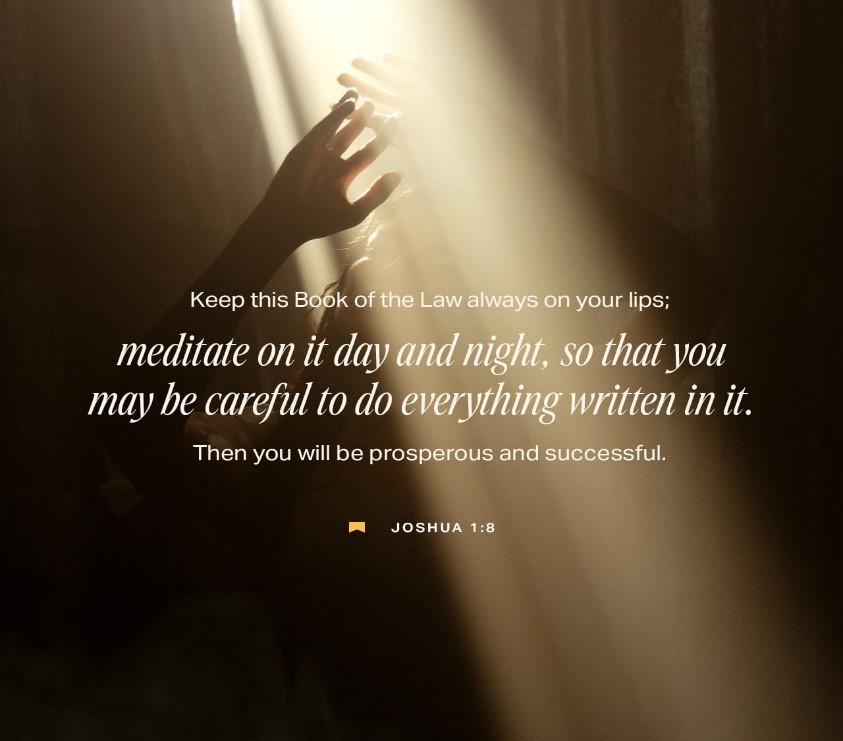
My goal was to always follow the words of Joshua 1:8 …

God told Joshua to always keep the Book of Law (The Bible) on his lips. That’s why it was for me and should be at the forefront of everything you do. God’s Words are the most important thing we can share with others on any given day and in any given circumstance.

God goes on to tell Joshua to meditate on it (The Bible – God’s Word) all the time, day and night. We need to be learners of God’s Word and to do that; we need to read, contemplate, learn, and understand what the Words of the Bible mean and what they are saying to us.

Jesus emphasized this in His final words to the disciples.

Jesus wants us to make learners (disciples) everywhere we go.

God says, Meditate on it (The Bible) day and night so that you may be careful to do everything written in it.”

Jesus’s edict is broader: ” Baptize them in the name of the Father and of the Son and of the Holy Spirit and teach them to obey everything I have commanded you.”

Finally, God says to Joshua:

Jesus tells His disciples:

God is always with His followers, disciples, and learners. If we follow the directions He gives us in the Bible, we will be prosperous and successful. Our prosperity doesn’t always come through riches, and neither does our success.

Being prosperous can mean having a loving husband or wife, and raising a God-loving family can be one of our greatest successes.

I’ve written a lot of words to this point, and here it is, the point that is.

Read, study, and meditate on God’s Word. Then, please share it with others. Be a teacher to a learner. God’s Spirit will guide you and always be with you.

Always remember God’s Words to Joshua in 1:9.

Faithfulness

I was a young kid back in the 1950s. My favorite day of the week was Saturday, which was the day all my favorite television shows were on.

The Adventures of Superman, Mighty Mouse, Sky King, and Howdy Doody are just a few. But my favorite show was The Lone Ranger.

Here’s how the show opened each week:

  • Narrator: The Lone Ranger!
  • [gunshots are fired]
  • The Lone Ranger: Hi-Yo, Silver!
  • Narrator: A fiery horse with the speed of light, a cloud of dust, and a hearty “Hi-Yo Silver” – the Lone Ranger!
  • The Lone Ranger: Hi-Yo, Silver, away!
  • Narrator: “With his faithful Indian companion, Tonto, the daring and resourceful masked rider of the plains, led the fight for law and order in the early West. Return with us now to those thrilling days of yesteryear. The Lone Ranger rides again!”

The Lone Ranger and Tonto are fictional characters. The Lone Ranger was a former Texas Ranger who, along with other rangers, was ambushed by The Cavendish Gang. Tonto found one ranger half dead. He cared for him, and together, they fought for justice in the old West.

My favorite line from the intro above is, “With his faithful Indian companion, Tonto.” Fought for law and order.

Faithful is not a word we use very often anymore. More often, we hear the word unfaithful used. Unfaithful is used to refer to married couples as well as those dating. Politicians are sometimes found to be unfaithful to their constituents, and often, a person we consider to be a friend is unfaithful to us in many ways.

The word “Emet” is used quite often in the Hebrew Bible.

Faithfulness goes both ways. God is faithful to us, but He also expects us to be faithful to Him and others.

The Bible repeatedly talks about God’s faithfulness to His creation (us).

“O LORD, you are my God;
I will exalt you; I will praise your name,
for you have done wonderful things,
plans formed of old, faithful, and sure.”

“Let us hold fast the confession of our hope without wavering, for he who promised is faithful.”

“If we confess our sins, he is faithful and just to forgive us our sins and to cleanse us from all unrighteousness.”

Not once in the 66 books of the Bible is God, Jesus, or the Holy Spirit ever referred to as unfaithful.

God is always faithful to us. He loves and encourages us and is always there for us in good and bad times.

The Lone Ranger was originally a radio show. Even in those old radio shows, Tonto was depicted as faithful to the Lone Ranger.

As good as the Lone Ranger radio and television series are, they are a product of someone’s imagination.

God is not an imaginary person. He is the creator of all things and sent His Son, Jesus, to die for our sins.

God is faithful. He made a promise to send a redeemer, and He did. Great is His faithfulness.

The Great Commission

Not everyone learns or understands instructions the same way. I can read an instruction manual to put together a bookcase, but doing so is very difficult for me as I am meticulous when I put things together. I learn best by example. Once someone has shown me how to do something several times, I become a master of that job.

Let’s take a moment to read Jesus’ final instructions to His disciples from the book of Matthew.

The passage you just read were the final words Jesus said to His followers before He ascended into heaven. Jesus had been on a mission His whole life, but His most fruitful years had been His last three.

During the last three years of His life, Jesus’ ministry moved forward like a runaway train. He was Baptized, tested by Satan, taught nonstop, and performed an innumerable number of miracles. Jesus healed, cared for others, served others, was arrested without just cause, beaten, sentenced to death, crucified on a cross, buried, and finally rose from the dead. And He did all of that for you and me.

One of the first lines that strikes me in the passage from Matthew is when he says, “Then the eleven disciples went to Galilee, to the mountain where Jesus had told them to go. When they saw him, they worshiped him, but some doubted.”

It isn’t easy to understand why some of them doubted. The disciples had traveled with Jesus for three years. From everything we’ve read in the Gospel accounts, we know that Jesus led by example. Jesus taught His twelve followers, now eleven, so much. And He reiterated many of His teachings over and over again. (Much like the way I learn)

Did the disciples doubt Jesus’ teachings? I doubt it. Did they doubt that He was the Son of God? Probably not. Did they not believe that Jesus rose from the dead? Definitely not! He was standing right in front of them on many occasions after His death.

So, why did some of the disciples’ doubt? Probably, they didn’t grasp what was in store for them next. In just three verses, Jesus enlightens them.

  Jesus gave four distinct instructions in His final address to His followers.

  1. Go – What does “Go” mean to you? (Think about it; you can’t make disciples by sitting in your house. You must go out and meet the people, be an example through your actions, and talk to others about Jesus whenever possible.)
  • Make disciples – What does “Make disciples” mean to you? (In Greek, the word disciples means “learner.”  Just as we need to read and hear about God’s plan and His Son Jesus, we, as learners, need to cultivate other learners and believers.)
  • Teach – What does “Teach” mean to you in this passage? (We are to pass on Christ’s teachings verbally, by our actions, and through His words in the Bible.)
  • Baptize—I thought only Pastors could baptize. What do you make of Jesus’s statement concerning baptism? (By instructing and teaching others about Jesus, we can help them get baptized through the Holy Spirit. Remember what Jesus said in John 3: You must be baptized through water and the Word of God to be reborn.)

Finally, Jesus makes a promise, “And surely, I am with you always, to the very end of the age.”

Jesus promised to be with us always. He lives with us in our hearts through The Holy Spirit, who is our guide and helper throughout our lives.

The Second Miraculous Catch

It’s an old saying. “History repeats itself.” The expression is right up there with the definition of insanity. “Doing the same thing over and over again and expecting different results.”

There are times in the Bible when history seems to repeat itself. To some extent, it does, but always for a perfectly good reason.

In chapter five of Luke’s Gospel, Jesus told some of His soon-to-be disciples to put into deeper water to catch fish. This was their response in what is called “The first miraculous catch.”

“Getting into one of the boats, which was Simon’s, he asked him to put out a little from the land. And he sat down and taught the people from the boat. And when he had finished speaking, he said to Simon, “Put out into the deep and let down your nets for a catch.” And Simon answered, “Master, we toiled all night and took nothing! But at your word, I will let down the nets.” And when they had done this, they enclosed a large number of fish, and their nets were breaking. They signaled to their partners in the other boat to come and help them. And they came and filled both the boats so that they began to sink. But when Simon Peter saw it, he fell down at Jesus’ knees, saying, “Depart from me, for I am a sinful man, O Lord.” For he and all who were with him were astonished at the catch of fish that they had taken, and so also were James and John, sons of Zebedee, who were partners with Simon. And Jesus said to Simon, “Do not be afraid; from now on, you will be catching men.”

__________________________________________________________

Now let’s take a few moments to read the story of “The Second Miraculous Catch” as a comparison:

“After this, Jesus revealed himself again to the disciples by the Sea of Tiberias, and he revealed himself in this way. Simon Peter, Thomas (called the Twin), Nathanael of Cana in Galilee, the sons of Zebedee, and two others of his disciples were together. Simon Peter said to them, “I am going fishing.” They said to him, “We will go with you.” They went out and got into the boat, but that night, they caught nothing.

Just as day broke, Jesus stood on the shore, yet the disciples did not know it was Jesus. Jesus said to them, “Children, do you have any fish?” They answered him, “No.” He said to them, “Cast the net on the right side of the boat, and you will find some.” So, they cast it, and now they could not haul it in because of the quantity of fish. That disciple whom Jesus loved, therefore, said to Peter, “It is the Lord!” When Simon Peter heard that it was the Lord, he put on his outer garment, for he was stripped for work and threw himself into the sea. The other disciples came in the boat, dragging the net full of fish, for they were not far from the land but about a hundred yards off.

When they got out on land, they saw a charcoal fire in place, with fish laid out on it and bread. Jesus said to them, “Bring some of the fish that you have just caught.” So, Simon Peter went aboard and hauled the net ashore, full of large fish, 153 of them. And although there were so many, the net was not torn. Jesus said to them, “Come and have breakfast.” Now, none of the disciples dared ask him, “Who are you?” They knew it was the Lord. Jesus came and took the bread and gave it to them, and so with the fish. This was now the third time that Jesus was revealed to the disciples after he was raised from the dead.”

As I’ve mentioned in several of my Lenten devotions, living on this side of history, so much of the Bible makes sense when we read it in context. The Bible explains itself. In this instance, this miracle in Luke set up the miracle of the second miraculous catch in John’s Gospel.

  • In Luke’s Gospel, the disciples barely knew Jesus.

John’s Gospel story occurs after Jesus had died and risen.

  • In Luke’s story, Peter complains that the men are tired and had been fishing all night with negative results.

In John, there is no indication that Peter or the disciples hesitated.

  • In Luke’s story, Peter fell to his knees and begged Jesus to depart from him because he was a sinful man.

In John’s story, Peter couldn’t get out of the boat fast enough to see and be with Jesus.

  • The men caught a lot of fish both times after listening to Jesus
  • In Luke’s story, Jesus tells Peter to follow Him because from now on, he’d be catching men

In John’s story, Jesus calls the seven men who have been following Him for three years to “Come and have some breakfast.”

Later in the story, Jesus would also call upon Peter to feed His sheep several times, thus forgiving him for disavowing Him on the night He was betrayed. And re-establishing him (Peter) as His follower and the leader of the disciples.

Everything Jesus did during His earthly ministry was done for a specific reason. Every word he spoke, every action He took or didn’t take, fulfilled His reason for being here. He was here as a living sacrifice. His disciples were to continue to carry on His message of repentance, grace, and faith to the next generation.

That, too, is our job. To answer the call and bring the Gospel message of Jesus Christ to the world so all might be saved.

On the Road to Emmaus

As we’ve all experienced, the road of life takes many twists and turns. Some of the twists and turns are good, and some of them are not so good. We experience many ups and downs throughout our lives. There are times when we have many successes, a good job, a great vacation, and happy families. But there are times in our lives when things don’t go very well. A family member passes, we fail a course at school, and we may walk into work on a Monday morning with a pink slip awaiting us.

Two of the disciples had one of those negative twists occur to them. Jesus had been crucified; He was dead. They had followed Him for a long time, and now, everything seemed hopeless. As they took the road from Jerusalem towards Emmaus, their lives took a sudden turn for the good.

Now, that same day, two of them were going to a village called Emmaus, about seven miles (24:13 Or about 11 kilometers) from Jerusalem. They were talking with each other about everything that had happened. As they talked and discussed these things with each other, Jesus himself came up and walked along with them; but they were kept from recognizing him.

They stood still, their faces downcast. One of them, named Cleopas, asked him, “Are you the only one visiting Jerusalem who does not know the things that have happened there in these days?”

“What things?” he asked.

“About Jesus of Nazareth,” they replied. “He was a prophet, powerful in word and deed before God and all the people. The chief priests and our rulers handed him over to be sentenced to death, and they crucified him, but we had hoped that he was the one who was going to redeem Israel. And what is more, it is the third day since all this took place. In addition, some of our women amazed us. They went to the tomb early this morning but didn’t find his body. They came and told us that they had seen a vision of angels who said he was alive. Then some of our companions went to the tomb and found it just as the women had said, but they did not see Jesus.”

He said to them, “How foolish you are, and how slow to believe all that the prophets have spoken! Did not the Messiah have to suffer these things and then enter his glory?” And beginning with Moses and all the Prophets, he explained to them what was said in all the Scriptures concerning himself.

As they approached the village to which they were going, Jesus continued as if he were going farther. But they urged him strongly, “Stay with us, for it is nearly evening; the day is almost over.” So, he went in to stay with them.

When he was at the table with them, he took bread, gave thanks, broke it, and began to give it to them. Then their eyes were opened, and they recognized him, and he disappeared from their sight. They asked each other, “Were not our hearts burning within us while he talked with us on the road and opened the Scriptures to us?”

They got up and returned at once to Jerusalem. There, they found the Eleven and those with them, assembled together and saying, “It is true! The Lord has risen and has appeared to Simon.” Then the two told what had happened on the way and how Jesus was recognized by them when he broke the bread.”

Looking back at the scripture reading, we see two of Christ’s disciples walking on the road to Emmaus, which means they were walking away from Jerusalem. These men were walking away from the place where Christ died at Golgotha. (Perhaps they were disillusioned, or they had given up hope. They said as much to Jesus as He walked with them. They said, “We had hoped He would be the redeemer of Israel.”)

I find it interesting that in the short time, Jesus walked with these two disciples, He opened their eyes to so many things. The Bible passage above from Luke says,

“He said to them, “How foolish you are, and how slow to believe all that the prophets have spoken! Did not the Messiah have to suffer these things and then enter his glory?” And beginning with Moses and all the Prophets, he explained to them what was said in all the Scriptures concerning himself.”

The distance between Jerusalem and Emmaus is about 20 miles. The Bible doesn’t state how far along the road the disciples were when they encountered Jesus. We do know they were just outside Emmaus when they stopped. So, somewhere between 1 and 19 miles, the disciples encountered Jesus. He explained the scriptures to them in that short distance, beginning with Moses. (Perhaps they stopped and sat for periods of time along the way).

Looking back at the scripture reading, what opened their eyes? What suddenly caused them to recognize Jesus? (They said it was the breaking of the bread, not necessarily as in communion, but as a shared meal.)

No sooner did Jesus disappear while seated with the two disciples, the men decided to return to Jerusalem. (They wanted to report to the Apostles and Christ’s other followers that they had seen Him, Jesus, He was alive.)

The passage from Luke states that Jesus revealed the scriptures to the two disciples on the road. Here is some of what the prophet Isaiah foretold about Jesus.

Who has believed what he has heard from us?

And to whom has the arm of the Lord been revealed?

For he grew up before him like a young plant,

and like a root out of dry ground;

he had no form or majesty that we should look at him,

and no beauty that we should desire him.

He was despised and rejected by men,

a man of sorrow and acquainted with grief;

and as one from whom men hide their faces

he was despised, and we esteemed him not.

Surely, he has borne our griefs

and carried our sorrows;

yet we esteemed him stricken,

smitten by God and afflicted.

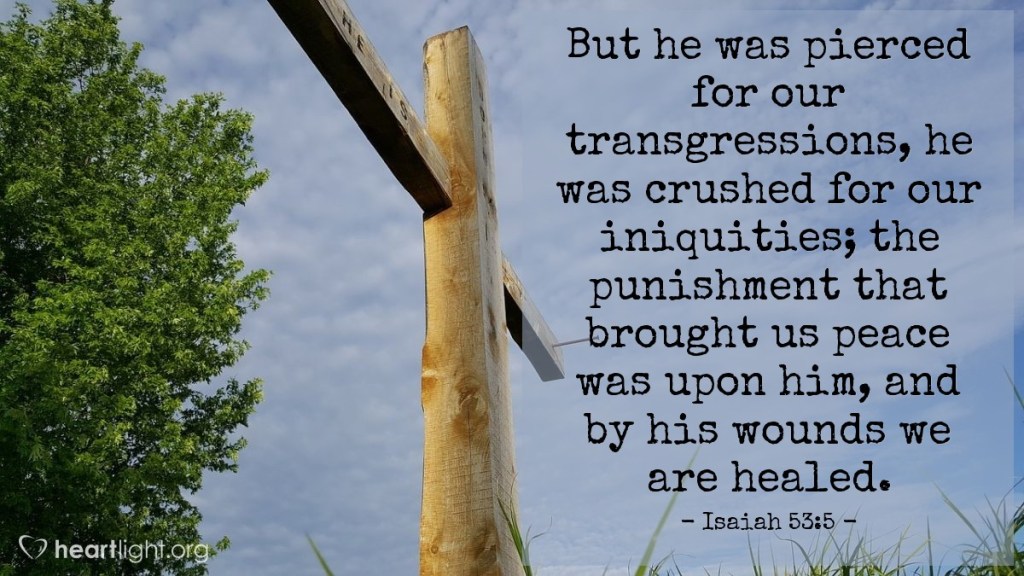
But he was pierced for our transgressions;

he was crushed for our iniquities;

upon him was the chastisement that brought us peace,

and with his wounds, we are healed.

All we, like sheep, have gone astray;

we have turned—every one—to his own way;

and the Lord has laid on him

the iniquity of us all.”

Everything that Jesus did on earth was prophesied in the Old Testament. Christ fulfilled the scriptures. He lived a perfect life. He taught us how to live ours as servants to all. Jesus died on the cross, and three days later, He rose again from the dead for you and me so we may have eternal life with Him and the Father. No greater love than this has ever been shown.

Resurrection Sunday

All four Gospels (Matthew, Mark, Luke, and John) describe the Resurrection. Each writer has his own perspective, with slight differences in each account. But one thing is for sure: in all four accounts, Jesus has risen. He has risen indeed.

Let’s take a look at Matthew’s account of the Resurrection:

We find Mary Magdalene and the other Mary (The mother of James and Joses) arriving at the tomb. Mark’s Gospel is a bit more specific in that he states that they came with spices to anoint the body of Jesus.

Here’s another thought from Mark’s Gospel. In it, the women were worried about how they would move the stone to enter the tomb. Matthew’s Gospel solves that problem by describing another earthquake that occurred (Remember the first one? It was at the moment of Jesus’ death).

The earthquake occurs when an angel descends from heaven and rolls the stone away.

Okay, so do you remember the devotion yesterday about the guards? Well, here they are again. When all this commotion occurs, and they see what happens, Matthew’s account says, And for fear of him the guards trembled and became like dead men.”

The words, ‘dead men” are open to a bit of interpretation. The guards could have possibly passed out from fear, thus laying on the ground like they were dead. They also could have been so terrified and stunned by what they had just observed that they couldn’t speak or move.

Either way, you’ll notice that the angel acts like the guards aren’t even there. He addresses the women, not the guards. He says these words, “Do not be afraid.” Hold those words in the back of your mind for a moment as we continue.

The angel wastes no time in telling the women what has occurred. Jesus has risen from the grave just like He said that He would. The angel then tells them to go and tell the disciples what they have seen and that they should go to Galilee, where Jesus will meet them.

Okay, please pardon my interruption at this point. But once again, we find the disciples not listening to what Jesus tells them to do. In Matthew 26:32, at the Last Supper, Jesus says,But after I am raised up, I will go before you to Galilee.” That’s once; now, the angel tells the women to pass the same information on to the disciples. So that’s twice they’ve been told to go to Galilee.

As the infomercials say, “But wait, there’s more.” Suddenly, Jesus appears to the women as they leave and says, “Greetings!” And they came up and took hold of his feet and worshiped him. Then Jesus said to them, “Do not be afraid; go and tell my brothers to go to Galilee, and there they will see me.”

And that is the third time. Jesus passed this information along twice, and the angel reinforced it.

So, the women return and tell them what they heard and say, and the disciples believe them, correct? NOT! Luke’s Gospel, 24:10-12, says,

Yes, the disciples doubted the women and had to see it for themselves. Only after Jesus had appeared to the disciples several times did they go to Galilee, where Jesus gave them The Great Commission.

Finally, remember I told you to tuck the words “Do not be afraid” into the back of your mind? I did that because it’s essential. The phrase is used over and over again in the New Testament. The angel appears to Zechariah and says, “Do not be afraid.” The angel appears to Mary and says? Yep, “Do not be afraid.” When the angels appeared to the shepherds, he said, “Do not be afraid.”

It’s true, they didn’t need to be afraid, nor do we. Remember what Psalm 23 says?

There is no need for us to fear because Jesus overcame death by His death on the cross and His Resurrection. And it’s also true, as Jesus said in His final words of Matthew’s Gospel, And behold, I am with you always, to the end of the age.”

Jesus’ Tomb is Sealed and Guarded

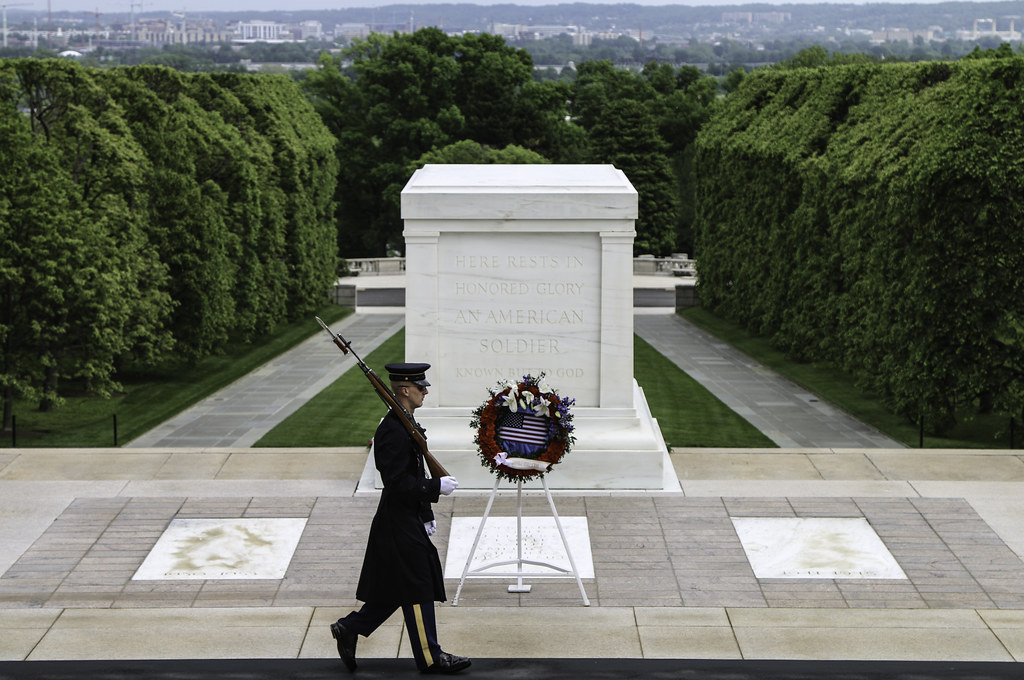
On March 4, 1921, the United States Congress approved the burial of an unidentified American serviceman from World War I in the plaza of the new Memorial Amphitheater. On November 11, 1921, the unknown soldier brought back from France was interred below a three-level marble tomb. The bottom two levels are six granite sections each, and the top has at least nine blocks with a rectangular opening in the center of each level through which the unknown remains were placed through the Tomb and into the ground below. A stone slab, rather than marble, covers the rectangular opening.

The caskets of the WWII & Korean unknowns arrived in Washington on May 28, 1958, where they lay in the Capitol Rotunda until the morning of May 30, when they were carried on caissons to Arlington National Cemetery. President Eisenhower awarded each the Medal of Honor, and the Unknowns of World War II and the Korean War were interred in the plaza beside their World War I comrade.

Twenty-four hours a day, soldiers from the 3rd U.S. Infantry Regiment, known as “The Old Guard,” stand watch over the Tomb. (Wikipedia)

It’s quite a sight watching the changing of the guard at the Tomb of the Unknown Soldier. I had the privilege of watching it in person many years ago. The most amazing thing to me is that the soldiers guarding the Tomb do so in all kinds of weather, 24/7/365.

In today’s devotion, the chief priests and the Pharisees ask Pilate to station guards at the Tomb of Jesus. Not to honor him but instead to guard against the disciples stealing the body.

Think about what’s happening in this passage:

  • We see the Pharisees and chief priests breaking the Sabbatical rules. These are the same ‘guys’ that accused Jesus of breaking the Sabbath when He performed a miracle.

Now, they were working on the Sabbath, soliciting Pilate for help.

  • At this point in time, if I were Pilate, I’d be done with these guys. And guess what? He was.
  • Depending on which version you read, there is a discrepancy between who sent the guards to watch over Jesus’ Tomb.

The word “Ye” means YOU. Pilate basically tells the religious leaders, “You have Temple guards; use them and secure the tomb the best that you can,” and that’s precisely what they did.

The most humorous part of this endeavor is that the priests and Pharisees worry about something that never entered the disciples’ minds.

One of the disciples, Judas, is dead, another disavowed knowing Jesus, Peter, and only one, John, showed up at the crucifixion. They were scared, disillusioned, depressed, and scattered. Grave robbing was the last thing on their minds.

We’re going to take a time jump now. We encounter these guards, Pharisees, and chief priests again about 24-36 hours later. The guards were there when Jesus rose from the dead. Did they see Jesus? No. But they felt another earthquake; they saw an angel roll the stone away from the Tomb. (By the way, the angel rolled the stone away not to let Jesus out, but to let people in, to see that the Tomb was empty.)

Now, it is Resurrection Sunday. Jesus has risen. The women have come to the Tomb to anoint the body. The angel tells the women, “He has Risen.” Mary sees Jesus. The women left to go tell the disciples what they had encountered.

And now Matthew picks up the story of the guards again:

“While they were going, behold, some of the guards went into the city and told the chief priests all that had taken place. And when they had assembled with the elders and taken counsel, they gave a sufficient sum of money to the soldiers. They said, “Tell people, ‘His disciples came by night and stole him away while we were asleep.’ And if this comes to the governor’s ears, we will satisfy him and keep you out of trouble.” So, they took the money and did as they were directed. And this story has been spread among the Jews to this day.”

Here are a few things to note from this passage

  • Who did the guards go to see first? The church elders and chief priests. This verifies the fact that these were temple guards, not Roman soldiers.
  • The elders and chief priests take the guard’s words as truth. They never question them or call them liars.
  • Instead, they pay them a large sum of money to keep quiet about what they have seen and tell them to lie about it.
  • Not only did the chief priests and elders bribe the guards with money, but they also promised anonymity if anyone questioned the story.
  • Why? Why did the elders and chief priests do this?

They wanted to maintain their hold on the people

They wanted to remain the ‘guys’ in charge of the temple and laws

  • Little did they know that Jesus would refute what they had done and show their lies simply by appearing to hundreds of people over the next 40 days.

These things were done out of fear, a lack of faith, and a desire to maintain power.

The Crucifixion of Jesus

Each year, my wife and I go to Good Friday services. The service doesn’t change much from year to year. How could it? We are told the same story each year. The horrors of Christ being crucified and hearing Him being mocked. We can visualize the other two crosses and Jesus conversing with the two robbers. We watch the soldiers throwing dice for Jesus’ clothing. In the crowd, we can see Mary, Jesus’ mother. Jesus tells the Apostle John, she’s your responsibility now; take care of her. And we hear Christ’s last words, “My God, my God, why have you forsaken me.”

Then it’s over. Jesus is dead, hanging on the cross. Living on this side of history, we know it’s not over. It’s just the beginning.

Here, I present you with Mark’s Gospel writings of the crucifixion. Each Gospel has a few differences, but the main thing is that Christ died on the cross for you and me.

May today be a day of remembrance, thankfulness, a bit of sadness, and immense joy. Why joy? Because Christ died, so we may live eternally.

(This is the AMP – Amplified Bible, with explanations throughout the reading)

“So, Pilate, wishing to satisfy the crowd, set Barabbas free for them, and after having Jesus, (I.e., whipped with a short whip of metal-tipped leather thongs. There was no limit to the number of lashings. Frequently, the body was so lacerated that the intestines gushed out. It was not uncommon for a prisoner to die from scourging.) scourged, he handed Him over [to his soldiers] to be crucified.

The soldiers led Him away into the palace (that is, the the residence of the Roman provincial governor. Praetorium), and they called together the entire [Roman] battalion [of 600 soldiers]. They dressed Him up in [a ranking Roman officer’s robe of] purple, and after twisting [together] a crown of thorns, they placed it on Him; and they began saluting and mocking Him: “Hail, King of the Jews!” They kept beating Him on the head with a (I.e., a long bamboo-like stick.) reed and spitting on Him and kneeling and bowing in [mock] homage to Him. After they had mocked Him, they took off the purple robe and put His own clothes on Him. And they led Him out [of the city] to crucify Him.

They forced into service a passer-by coming in from the countryside, Simon of (A port city in North Africa.) Cyrene (the father of Alexander and Rufus) (The crossbeam was usually placed on the nape of the neck like a yoke.) to carry His cross.

Then they brought Him to the Place [called] Golgotha, which is translated Place of a (Latin: Calvaria; or Calvary; Aram: Golgotha; Greek: Kranion.) Skull. 

They tried to give Him (The myrrh had a narcotic effect and was added to dull the senses.) wine mixed with myrrh [to dull the pain], but He would not take it. And they crucified Him and (See note Matt 27:35.) divided up His clothes among themselves, casting lots for them to see who should take what. It was the third hour (9:00 a.m.) when they crucified Him. The inscription of the accusation against Him had been written [above Him]: “THE KING OF THE JEWS.”

They crucified two robbers with Him, one on His right and one on His left.  [And the Scripture was fulfilled, which says, “He was counted with the transgressors.”] Those who were passing by were insulting Him with abusive and insolent language, wagging their heads [as a sign of contempt], and saying, “Ha! You who would destroy the temple and rebuild it in [only] three days, save Yourself by coming down from the cross!” In the same way, the chief priests also, along with the scribes, were ridiculing and mocking Him among themselves and, saying, “He saved others [from death]; He cannot save Himself! Let the Christ (the Messiah, the Anointed), the King of Israel, now come down from the cross, so that we may see and believe and trust [in Him]!” Those who were crucified with Him were also insulting Him.

When the sixth hour (noon) came, darkness covered the whole land until the ninth hour (3:00 p.m.). And at the ninth hour, Jesus cried out with a loud voice, “Eloi, Eloi, lama sabachthani?”—which is translated, “My God, My God, why have You forsaken Me?” Some of the bystanders heard Him and said, “Look! He is calling for (The Jews believed that the prophet Elijah would return before the Messiah appeared.) Elijah!” Someone ran and filled a sponge with sour wine, put it on a reed, and gave Him a drink, saying, “Let us see whether Elijah is coming to take Him down.” But Jesus uttered a loud cry and breathed out His last [voluntarily, sovereignly dismissing and releasing His spirit from His body in submission to His Father’s plan]. And the veil [of the Holy of Holies] of the temple was torn in two from (This act of God signified that the death of Jesus ended the need for temple sacrifices and intermediaries and opened the way for free and direct access to God.) top to bottom. When the centurion, who was standing opposite Him, saw the way He breathed His last [being fully in control], he said, “Truly, this man was the Son of God!”

Now, some women also were watching from a distance, among whom were Mary Magdalene and (Gr Maria. She is believed to be a sister or sister-in-law of Jesus’ mother, Mary (Gr Mariam). Mary, the mother of James the Less and of Joses, and (Matt 27:56 indicates that Salome was the mother of James and John, the sons of Zebedee. Salome is believed to be one of the sisters of Jesus’ mother, Mary.) Salome. When Jesus was in Galilee, they used to accompany him and minister to Him; there were also many other women who came up with Him to Jerusalem.

“He Washed Their Feet.”

In chapter four of my book, “Adventures in Youth Ministry,” I discuss TEACHING THEM TO BE COMFORTABLE PRAYING OUT LOUD.”

This chapter’s goal was to provide helpful hints on getting students comfortable praying out loud.

(Adventures in Youth Ministry, Chapter 4)

In the Gospel of John, chapter 13, beginning with verse one, Jesus and His disciples have come together for what we refer to as the Last Supper. Jesus and His followers are reclining at the Passover meal table when Jesus stands up and does a most peculiar thing, at least in the eyes of His disciples.

Jesus Washes the Disciples’ Feet

“Now before the Feast of the Passover, when Jesus knew that his hour had come to depart out of this world to the Father, having loved his own who were in the world, he loved them to the end. During supper, when the devil had already put it into the heart of Judas Iscariot, Simon’s son, to betray him, Jesus, knowing that the Father had given all things into his hands and that he had come from God and was going back to God, rose from supper. He laid aside his outer garments and, taking a towel, tied it around his waist. Then he poured water into a basin and began to wash the disciples’ feet and to wipe them with the towel that was wrapped around him. He came to Simon Peter, who said to him, “Lord, do you wash my feet?” Jesus answered him, “What I am doing, you do not understand now, but afterward you will understand.” Peter said to him, “You shall never wash my feet.” Jesus answered him, “If I do not wash you, you have no share with me.” Simon Peter said to him, “Lord, not my feet only but also my hands and my head!” Jesus said to him, “The one who has bathed does not need to wash, except for his feet, but is completely clean. And you are clean, but not every one of you.” For he knew who was to betray him; that was why he said, “Not all of you are clean.”

When he had washed their feet and put on his outer garments, and resumed his place, he said to them, “Do you understand what I have done to you? You call me Teacher and Lord, and you are right, for so I am. If I then, your Lord and Teacher, have washed your feet, you also ought to wash one another’s feet. For I have given you an example that you also should do just as I have done to you. Truly, truly, I say to you, a servant is not greater than his master, nor is a messenger greater than the one who sent him. If you know these things, blessed are you if you do them. I am not speaking of all of you; I know whom I have chosen. But the Scripture will be fulfilled, ‘He who ate my bread has lifted his heel against me.’ I am telling you this now, before it takes place, that when it does take place, you may believe that I am he. Truly, truly, I say to you, whoever receives the one I send receives me, and whoever receives me receives the one who sent me.”

“Jesus washed their feet. Twelve disciples, twenty-four feet, and He cleaned them. On his knees, Jesus got down on what was probably a filthy floor in the upper room. Jesus wrapped a towel around His waist, which comes in handy when washing twenty-four feet. Then, He started working.

This was servant work, not something He should do! He was their leader, He was their teacher, and He was the guest of honor that night at the Passover meal. This scene happened over 2000 years ago in Jerusalem. There weren’t many paved roads back then, so the streets were dusty and muddy when it rained. So, it was customary for the homeowner or host to provide a slave at the house’s door to wash the dinner guests’ feet as they arrived. If the home couldn’t afford a slave, the responsibility generally fell to one of the early arriving guests. Interestingly enough, none of the disciples volunteered for this common task. So, we find the upper room filled with proud hearts and dirty feet!

So, He, God, who once took a lump of clay and formed a man, washed their feet. The same God who was born in a dirty stable and laid in an animal’s feed trough. The same God who, in just a few minutes, would be offering His body and blood to his disciples during the Passover meal. He was the same God who would be tried, beaten, humiliated, whipped, crucified, and buried in just a few short hours.

Not just for those twelve disciples and twenty-four feet, but for all of us. He washed their feet as a servant. He loved them because He loves us.

On that first Maundy Thursday, Jesus taught His disciples a valuable lesson through experiential learning. By getting down on His knees and taking a basin and a towel, Jesus washed His disciples’ feet as a servant. Jesus lived amongst us as one who served. He modeled the lifestyle He wants us to live every day of our lives. When we selflessly and lovingly help others, we live as Christ wants us to.

Jesus used the basin of water and the towel to teach us the essence of service. His Holy Spirit lives within us and calls us to live our faith out loud through serving others.” (From my September 2019 Blog)