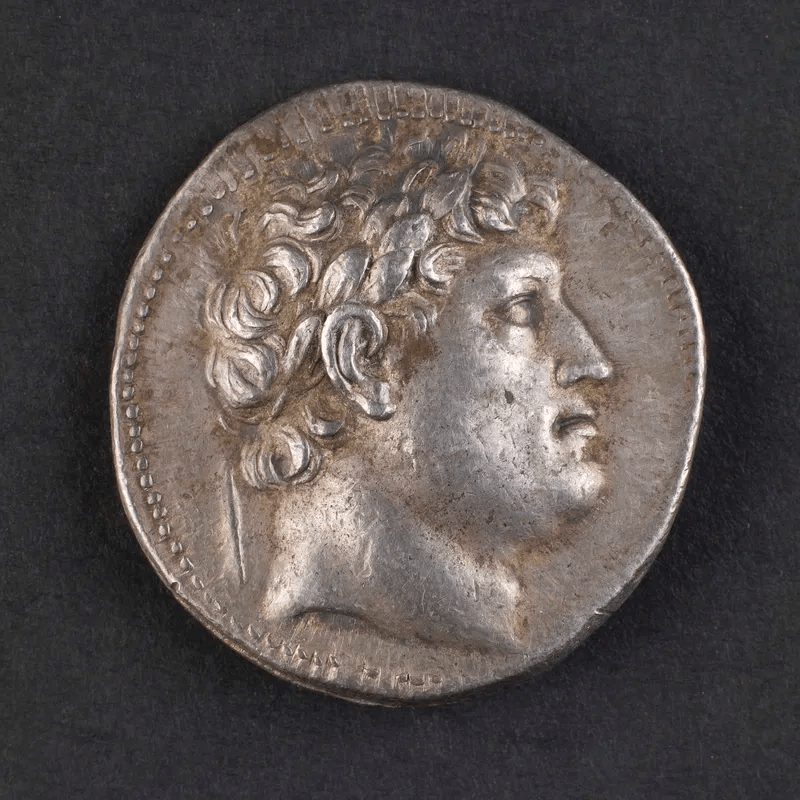
The Lost Coin, “I found twenty bucks.”

Lenten Devotions

A Walk through the Book of Luke

March 24, 2023

Luke 15:8-10

The Lost Coin

“I found twenty bucks.”

Whenever I have lost something and found it later, it has always brought me joy. There have been times in my life when I’ve lost a watch, a ring, my cell phone, and even money.

Whenever I found a lost item or money, I would share that joy with my wife. On one occasion, many years ago, I was emptying laundry out of the dryer. As I was folding the clothing, a $20 bill fell out of a pair of my jeans. To this day, I don’t remember how the $20 bill got there or where it came from. But I was delighted. In my mind, I was up twenty bucks.

In today’s devotion, a woman finds a coin she had lost.

********************The Point******************

This parable is relatively short. It is only three verses long. But, it is the second in Jesus’ lost and found stories found in Luke 15.

 “Or suppose a woman has ten silver coins (15:8 Greek ten drachmas,) each worth about a day’s wages, and loses one. Doesn’t she light a lamp, sweep the house and search carefully until she finds it? And when she finds it, she calls her friends and neighbors together and says, ‘Rejoice with me; I have found my lost coin.’ In the same way, I tell you, there is rejoicing in the presence of the angels of God over one sinner who repents.”

Luke 15:8-10

There is a noticeable difference between yesterday’s parable of the Lost Sheep and todays. In the parable of the Lost Sheep, the shepherd was likely a reasonably wealthy man. In today’s parable of the Lost Coin, our character is a poor woman who lives alone.

“The description of the woman lighting a lamp and sweeping her house confirms that she was a comparatively poor person living in a peasant’s small house with a low doorway and no windows.” (New Bible Commentary, 21st Century Edition, Luke 15, Pp. 1005.)

The woman in the parable does everything she can to find this lost coin (It was probably a drachma, which is worth a day’s wages). She lights a lamp, as there are no windows in her home, and sweeps the floor looking for the lost coin.

When she finds her coin and rejoices by celebrating with her neighbors, Jesus is once again emphasizing the joy in heaven over a single repentant sinner. It may seem like a small thing but remember that every person who repents their sinful ways and declares that Jesus Christ is their Lord and Savior is saved.

Finding a lost $20 bill in your pants pocket is terrific. But knowing you are saved by God’s Grace and your faith in Jesus Christ as your Lord and Savior beats finding lost cash in your pants pocket any day.

“Lost and Found,” The Lost Sheep

Lenten Devotions

A Walk through the Book of Luke

March 23, 2023

Luke 15:1-7

The Lost Sheep

“Lost and Found”

My wife, Kathy, and I both wear glasses. She wears reading glasses, and I must wear regular glasses when driving.

We took my grandson to the Magic Kingdom at Disneyworld about six years ago for the day. We were in Liberty Square when the daily parade came by. Kathy was in her wheelchair. My grandson and I sat on a bench and watched as the parade went by.

After the parade was over, we began walking through the park, more or less heading toward the park exit as we prepared to leave. At some point, my wife asked for her reading glasses. Unfortunately, her glasses were prescription, not the inexpensive over-the-counter type.

I realized I had left her glasses on the bench where we sat for the parade. So we quickly returned to the bench and realized the glasses were gone.

Honestly, I couldn’t imagine why someone would want her reading glasses. So, we walked to the front of the park where the lost and found was located. After waiting in line for a few minutes, I asked the person behind the counter if anyone had turned in a pair of reading glasses in a white case. The young man reached into a box, and there they were, the missing reading glasses. What was lost had been found.

Over the next three days, we’ll be reading and discussing three parables in Luke 15 that involve something being lost. Today, we’ll discuss the parable of, The Lost Sheep.

*******************************The Point**************************

Tax collectors, sinners, and even some Pharisees were listening to Jesus speak.

“Now the tax collectors and sinners were all gathering around to hear Jesus. But the Pharisees and the teachers of the law muttered, “This man welcomes sinners and eats with them.”

Then Jesus told them this parable: “Suppose one of you has a hundred sheep and loses one of them. Doesn’t he leave the ninety-nine in the open country and go after the lost sheep until he finds it? And when he finds it, he joyfully puts it on his shoulders and goes home. Then he calls his friends and neighbors together and says, ‘Rejoice with me; I have found my lost sheep.’ I tell you that in the same way, there will be more rejoicing in heaven over one sinner who repents than over ninety-nine righteous persons who do not need to repent.” Luke 15:1-7

This parable begins by telling us who stopped to listen to Jesus. They were tax collectors, sinners, and Pharisees. It’s interesting to note that Luke differentiates between tax collectors and sinners.

Tax collectors (like Jesus’ disciple Levi/Matthew) were known to be sinners, as they often kept a portion of paid taxes for themselves. In this case, sinners could mean anything from being a thief to immoral.

“It may, however, refer simply to persons who were not strict about fulfilling all the varied requirements of the ceremonial law. They were “sinners” in the eyes of the Pharisees because of their irreligious attitude.” “People’s Bible Commentary, Luke, Victor H. Prange, Pp. 172).

Once again, we hear the Pharisees mumbling under their breath about how Jesus was eating with sinners and tax collectors. As they murmured, they justified themselves as being better than Jesus as they would never do such a thing.

After all of this judging and comparisons, Jesus tells the parable of, The Lost Sheep.

For a shepherd to have a flock of one hundred was pretty standard. In the Bible, Jesus is referred to as the Shepherd and His followers as His sheep. There are times when a follower of Jesus leaves the flock. They either no longer believe or are “lost” because of circumstances that have occurred.

I’ve heard people say things like, “What kind of God would allow my child to die,” or, “My husband (or wife) left me for another woman (or man); how could He allow such a thing to happen.” “I’ve been out of work for almost a year; I’ve prayed, pleaded, and cried out to God. Yet, if He’s out there, I haven’t heard from Him!”

Then God touches their lives very specially, and everything becomes clear. They understand the why’s a little more clearly and once again reach out for their Savior.

This is when there is a celebration in heaven.

“God rejoices over he recovers of a lost sinner, and therefore it is Jesus’ supreme desire to seek and save the lost. This divine attitude is illustrated by the willingness of a shepherd to out over the hiss searching so that not even one sheep may be missing from the flock.” (New Bible Commentary, 21st Century Edition, Luke 15, Pp. 1005)

God always rejoices over those who return to Him repentant. However, he does not rejoice over those, like the Pharisees, who think they don’t need to repent because they are so righteous.

We are all sinners. And sometimes, we get a little lost in this world. But remember that our Good Shepherd, Jesus, is always waiting for His repentant children with open arms to return to Him.

The Cost of being a Disciple

Lenten Devotions

A Walk through the Book of Luke

March 22, 2023

Luke 14:25-35

The Cost of being a Disciple

“How many ears do you have?”

While in full-time ministry, I would lead chapel for the children in our church’s school every two weeks. In my last church, the children were relatively young. Their ages ranged from 3 to 5 years old.

To keep their attention during chapel, I needed to be creative. It wasn’t a church full of adults and teens on a Sunday morning; it was a church with 50—60 children. Their attention span was short, so I used a lot of visual aids.

Sometimes the kids would get a bit loud when I tried to speak. So, I would stop talking and not say anything for a moment. Then I would say, quite loudly, “How many mouths do you have? Most of them understood and would reply, “One?” Then I would say, “How many ears do you have, and they would reply, “Two!”

My following line always got their attention and made the adults smile. “So, if you have only one mouth and two ears, shouldn’t you listen twice as much as you talk.” And they would reply, “Yes!” It took a few times for them to get it, but they got it after the first few times I did this in chapel. They understood it was time to be quiet and listen.

At the end of today’s devotion, Jesus says,

“Whoever has ears to hear, let them hear.”

Let’s take a few moments to see why He said this.

**********************The Point*********************

Large crowds were traveling with Jesus, and turning to them, he said: “If anyone comes to me and does not hate father and mother, wife and children, brothers, and sisters—yes, even their own life—such a person cannot be my disciple. And whoever does not carry their cross and follow me cannot be my disciple.

 “Suppose one of you wants to build a tower. Won’t you first sit down and estimate the cost to see if you have enough money to complete it? For if you lay the foundation and are not able to finish it, everyone who sees it will ridicule you saying, ‘This person began to build and wasn’t able to finish.’

 “Or suppose a king is about to go to war against another king. Won’t he first sit down and consider whether he is able with ten thousand men to oppose the one coming against him with twenty thousand? If he is unable, he will send a delegation while the other is still a long way off and will ask for peace terms. In the same way, those of you who do not give up everything you have cannot be my disciples.

 “Salt is good, but how can it be made salty again if it loses its saltiness? It is fit neither for the soil nor for the manure pile; it is thrown out.

“Whoever has ears to hear, let them hear.”

Luke 14:25-33

The teaching in this passage is some of the hardest Christians can hear. In the passage above, Jesus gives three conditions for following Him. First, there needs to be a willingness to leave family ties.

This was difficult for Jesus’ followers then and is still today for you and me. In several of my past devotions, I mentioned how we need to prioritize our life and time.

God comes first

Family comes second

Work comes third

Friends come forth

And everything else comes after.

I can recall hearing the above statement on a motivational tape by Lee Iacocca (Former president of Ford motor company and CEO of Chrysler) about 25 years ago. I recall that he said many things changed when he changed his priorities (see above). One, in particular, was that many of his “friends” fell away when he and his wife declined dinner invitations because they had a family or church event to attend.

The second statement Jesus makes pertains to us carrying the cross. No, Jesus isn’t talking about us carrying a cross around with us.

“The cross here does not refer to the afflictions and troubles which commonly come in life to Christians and non-Christians alike. Rather the cross means to accept whatever suffering might result for a sincere commitment to Christ and His Kingdom.” (People’s Bible Commentary, Luke, Victor H. Prange, Pp.108)

The third statement Jesus makes is in reference to earthly possessions. This would include money. Jesus says we need to be willing to give them us in order to follow Him. It reminds me of the story of the rich young ruler.

“A certain ruler asked him, “Good teacher, what must I do to inherit eternal life?”

 “Why do you call me good? Jesus answered. “No one is good—except God alone. You know the commandments: ‘You shall not commit adultery, you shall not murder, you shall not steal, you shall not give false testimony, honor your father and mother.”

“All these I have kept since I was a boy,” he said.

When Jesus heard this, he said to him, “You still lack one thing. Sell everything you have and give to the poor, and you will have treasure in heaven. Then come, follow me.”

When he heard this, he became very sad because he was very wealthy. 

Jesus looked at him and said, “How hard it is for the rich to enter the kingdom of God! Indeed, it is easier for a camel to go through the eye of a needle than for someone who is rich to enter the kingdom of God.”

Those who heard this asked, “Who then can be saved?”

Jesus replied, “What is impossible with man is possible with God.”

Peter said to him, “We have left all we had to follow you!”

 “Truly I tell you,” Jesus said to them, “no one who has left home or wife or brothers or sisters or parents or children for the sake of the kingdom of God will fail to receive many times as much in this age, and in the age to come eternal life.”

Luke 18:18-30

That passage has some strong statements. The ruler seemed to be a follower, but he was unwilling to give up his earthly possessions to follow Jesus. Jesus’ statement at the end of the above passage makes it quite clear why it’s important to follow Him with no restrictions.

Truly I tell you,” Jesus said to them, “no one who has left home or wife or brothers or sisters or parents or children for the sake of the kingdom of God will fail to receive many times as much in this age, and in the age to come eternal life.”

Jesus then shares three parables. The first is about building a tower, and the second is about going to war. Both are about preparedness. We shouldn’t follow Jesus because it’s cool to do, and all the stories of His miracles, etc. Instead, we need to follow Him, knowing right up front there can be and is a cost in doing so. People may fall away from you because of your faith. Some people may criticize you, while others may try to hurt you because of your beliefs.

Believing in Jesus is only part of the equation.

“Only discipleship, only faith in Jesus and active faith (action) will save him from the fate of salt that has lost it’s taste.” (Concordia Self-Study Commentary, Luke, Pp.73.)

Finally, Jesus says, “Whoever has ears to hear, let them hear.”

“Fruitful hearing of the word is choked by the trials and temptation of this world, its riches and pleasures. The follower of Jesus needs to listen to everything he has to say, not only what one wants to hear,”

(People’s Bible Commentary, Luke, Victor H. Prange, Pp.171)

The Great Banquet

Lenten Devotions

A Walk through the Book of Luke

March 21, 2023

Luke 14:15-24

Jesus at a Pharisee’s house II

The Great Banquet

Throughout my lifetime, I have been to many banquets. Some were weddings, and others were retirement dinners. Others were big parties that one of my employers would throw for the employees and their spouses each year. Other banquets I attended were for a church function, which could also be quite elaborate.

After the food, beverages, dancing, and interactions with friends and family, these types of parties/banquets come to an end. People say their goodbyes and head home to their everyday lives and responsibilities.

In today’s Parable, Jesus speaks of another kind of banquet. This is a banquet that God invites everyone to, but unfortunately, not everyone accepts His invitation.

****************The Point****************

Today’s devotion is a continuation of yesterday’s reading. In yesterday’s parables, Jesus was discussing being a humble servant. Today, His point is slightly different.

“When one of those at the table with him heard this, he said to Jesus, “Blessed is the one who will eat at the feast in the kingdom of God.”

Jesus replied: “A certain man was preparing a great banquet and invited many guests. At the time of the banquet, he sent his servant to tell those who had been invited, ‘Come, for everything is now ready.’

 “But they all alike began to make excuses. The first said, ‘I have just bought a field, and I must go and see it. Please excuse me.’

 “Another said, ‘I have just bought five yoke of oxen, and I’m on my way to try them out. Please excuse me.’

 “Still another said, ‘I just got married, so I can’t come.’

 “The servant came back and reported this to his master. Then the owner of the house became angry and ordered his servant, ‘Go out quickly into the streets and alleys of the town and bring in the poor, the crippled, the blind, and the lame.’

 “ ’Sir,’ the servant said, ‘what you ordered has been done, but there is still room.’

 “Then the master told his servant, ‘Go out to the roads and country lanes and compel them to come in so that my house will be full. I tell you, not one of those who were invited will get a taste of my banquet.’ ”

Luke 14:15-24

This Parable was told by Jesus because of what someone at the table said.

“Blessed is the one who will eat at the feast in the kingdom of God.”

The banquet is what might be called “God’s Salvation Banquet.” Jesus is the servant sent out by God the Father to call people to repentance and faith. The guests invited to the banquet but refused the invite for various reasons are the people of Israel, as the teachers of the law and Pharisees. The church leaders rejected Jesus. They did not believe He was who he said He was, The Son of God.

Jesus, the servant, went out into the nation of Israel and was rebuked. Then He went back out, inviting the lame, the sick (including those with the sickness of sin), the crippled, and the blind. This is the same group of people Jesus referenced in yesterday’s devotion.

The servant/Jesus reports that many had come to the banquet from this group. But there is still room at the table (The Kingdom of God), so the servant is sent out a third time. Now to the rural areas where the gentiles live, many of them come to the banquet.

Everyone is invited to God’s banquet table, Jews, Gentiles, young and old, rich and poor, sick and needy. But unfortunately, many people reject Christ’s call to repent and have faith in the His Gospel message.

Those who reject God’s invitation have only what this world offers and nothing more. But, on the other hand, those who grasp onto the invite will enjoy everlasting life.

Nothing has changed. It was the same today as it was 2000 years ago. We are saved (B.G.T.F). By Grace (God’s unconditional, undeserved love) Through Faith (Our belief that God sent His only Son to be a living sacrifice for our sins, so we may live with Him in eternity forever.)

Jesus has invited everyone to the Kingdom Banquet. Our job is to share the Gospel message with others, so they may repent and have faith in Christ. We want everyone to join us at the banquet.

“Healing a man with dropsy”

Lenten Devotions

A Walk through the Book of Luke

March 20, 2023

Luke 14:1-14

Jesus at a Pharisee’s house

“Healing a man with dropsy.”

The Gospels speak of many ailments. We’ve read and listened to the healings by Jesus of blindness, deafness, leprosy, bleeding, and demon possession. In today’s reading from Luke, Jesus heals a man with dropsy.

Today we no longer call the ailment the man had dropsy; now, it’s referred to as Edema. Edema is characterized by excess watery fluid collecting in the body’s cavities or tissues. Usually, this illness is connected with congestive heart failure, as well as liver or kidney failure.

In today’s lesson, Jesus also shares two parables. First, he is at the home of a Pharisee enjoying a meal. He uses the example of a banquet in each of them.

*******************The Point*******************

Let’s look at today’s reading from the book of Luke.

“One Sabbath, when Jesus went to eat in the house of a prominent Pharisee, he was being carefully watched. There in front of him was a man suffering from abnormal swelling of his body. Jesus asked the Pharisees and experts in the law, “Is it lawful to heal on the Sabbath or not?” But they remained silent. So, taking hold of the man, he healed him and sent him on his way.

Then he asked them, 

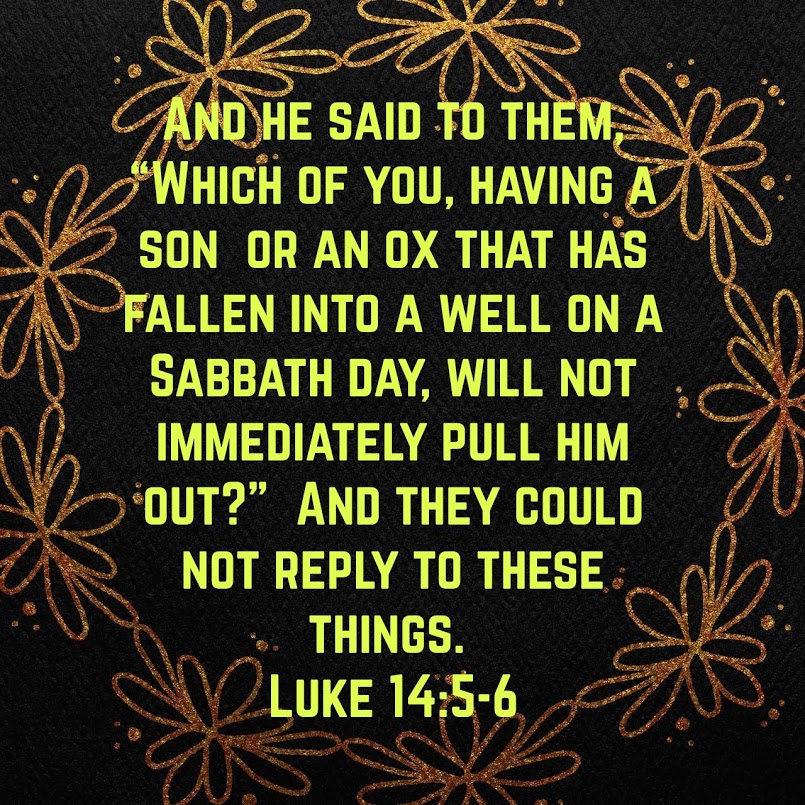
“If one of you has a child or an ox that falls into a well on the Sabbath day, will you not immediately pull it out?”

And they had nothing to say.

When he noticed how the guests picked the places of honor at the table, he told them this parable: “When someone invites you to a wedding feast, do not take the place of honor, for a person more distinguished than you may have been invited. If so, the host who invited both of you will come and say to you, ‘Give this person your seat.’ Then, humiliated, you will have to take the least important place. But when you are invited, take the lowest place so that when your host comes, he will say to you, ‘Friend, move up to a better place.’ Then you will be honored in the presence of all the other guests. For all those who exalt themselves will be humbled, and those who humble themselves will be exalted.”

Then Jesus said to his host, “When you give a luncheon or dinner, do not invite your friends, your brothers or sisters, your relatives, or your rich neighbors; if you do, they may invite you back, and so you will be repaid. But when you give a banquet, invite the poor, the crippled, the lame, the blind, and you will be blessed. Although they cannot repay you, you will be repaid at the resurrection of the righteous.”

Luke 14:1-14

One has to wonder why a person with dropsy was at the home of a Pharisee. The passage notes that Jesus was being carefully watched. Perhaps the Pharisee invited the ailing man to see if Jesus would heal him on the Sabbath. This would result in Jesus being trapped and accused of not following the Sabbatical rules.

In his case, before healing the man, Jesus asks the Pharisees and experts of the law a question:

When Jesus did ask a question about what was lawful on the Sabbath, He was never asking permission. Instead, Jesus was putting the religious leaders on the spot. Nevertheless, in each case, He always healed the ailing person.

In today’s devotion, Jesus’ follow-up question speaks to the heart of the matter concerning the Sabbath.

Jesus was trying to tell the religious leaders that love comes first. The Pharisees and religious leaders were concerned about following the letter of the law. Jesus emphasized that people’s well-being is more important than following the Sabbatical law to the letter.

I’m not saying we shouldn’t follow the commandments or rules in general. The regulations and laws are put in place for a reason. But, at the same time, we must put the well-being of others first.

As I mentioned earlier, Jesus also shared two parables at the Pharisee’s house.

First, Jesus says:

 “When someone invites you to a wedding feast, do not take the place of honor, for a person more distinguished than you may have been invited.”

“As a parable, it has a spiritual significance. A wedding feast was a recognized symbol for the kingdom of God and heavenly bliss. This parable is based on the practice of seating guests at table by rank and distinction. The more important guests arrive last, and an unwary early arrival might have to be moved to a lower place so to accommodate them. Far better to adopt a position of modest and wait to be invited to a better seat. For God exalts humble and debases the proud.” (New Bible Commentary, 21st Century Edition, Luke 14, Pp. 1004)

Jesus is saying that rather than be self-seeking and putting ourselves on a pedestal, we should be humble to our fellow man. Just as Jesus was humbly born in a stable and later got on His knees to wash His disciples’ feet. We, too, should be unpretentious and servants to others.

Then Jesus presented a second parable.

“When you give a luncheon or dinner, do not invite your friends, your brothers or sisters, your relatives, or your rich neighbors; if you do, they may invite you back, and so you will be repaid. But when you give a banquet, invite the poor, the crippled, the lame, the blind, and you will be blessed. Although they cannot repay you, you will be repaid at the resurrection of the righteous.”

In the second parable, Jesus directed it at His host.

Jesus tells His host that you will be paid back when you invite your friends, brothers and sisters, relatives, and rich neighbors. In other words, they will eventually ask you to their homes for dinner.

But what about the poor, crippled, lame, and blind. Jesus is saying that these are people who are generally unable to reciprocate with an invitation back to you. Jesus is not condemning His host for inviting friends and family to his home. Jesus himself did not fall into any of the people in the second category.

Let’s think of it this way. What about that homeless person on the street corner asking for food or money? How about an older adult who rarely leaves their home because they are never invited to join someone for dinner? Or the disabled person who would like to come to church on Sunday but doesn’t have transportation.

These are the people that need help but generally cannot reciprocate. And that’s okay! Of course, don’t have a self-seeking attitude when you help others. But know that you are doing God’s work, and He sees what you are doing in His name.

We don’t know if the reprimands Jesus gave in these parables hit home or not. But, I’m sure Jesus hopes that, at the very least, His disciples will have heard His words and learned to practice humility.

Jesus heals a man born blind

Lenten Devotions

Gospel Lesson for Sunday

March 19, 2023

John 9:1-12; Genesis 3:9-13; Matthew 28:18-20

Jesus heals a man born blind

It’s all your fault!

As I’ve gotten older, I’ve found it amusing how often we play the ‘blame game’ throughout our lives.

When we’re kids, we blame our sibling or a neighbor kid for something we did to not get in trouble. “I didn’t leave the bicycle in the driveway. Johnny did it.”

The blaming of someone else for a problem continues as we get older. We’ll blame a colleague for something we did at work or perhaps were both responsible. “Honey, why didn’t you pick up pasta from the store as I asked you?” We might reply, “I don’t recall you ever asking me to do that.” Even when you now remember she did.

The blame game goes all the way back to Genesis in the Bible:

“But the Lord God called to the man and said to him, “Where are you?” And he said, “I heard the sound of you in the garden, and I was afraid because I was naked, and I hid myself.” He said, “Who told you that you were naked? Have you eaten of the tree of which I commanded you not to eat?” The man said, “The woman whom you gave to be with me, she gave me fruit of the tree, and I ate.” Then the Lord God said to the woman, “What is this that you have done?” The woman said, “The serpent deceived me, and I ate.” Genesis 3:9-13

**************************The Point***********************

Today’s devotion includes the blame game I spoke about above.

“As he went along, he saw a man blind from birth. His disciples asked him, “Rabbi, who sinned, this man or his parents, that he was born blind?”

 “Neither this man nor his parents sinned,” said Jesus, “but this happened so that the works of God might be displayed in him. As long as it is day, we must do the works of him who sent me. Night is coming when no one can work. While I am in the world, I am the light of the world.”

After saying this, he spit on the ground, made some mud with the saliva, and put it on the man’s eyes. 

“Go,” he told him, “wash in the Pool of Siloam” (this word means “Sent”).

So, the man went and washed and came home seeing.

His neighbors and those who had formerly seen him begging asked, “Isn’t this the same man who used to sit and beg?” Some claimed that he was.

Others said, “No, he only looks like him.”

But he himself insisted, “I am the man.”

“How then were your eyes opened?” they asked.

He replied, “The man they call Jesus made some mud and put it on my eyes. He told me to go to Siloam and wash. So, I went and washed, and then I could see.”

“Where is this man?” they asked him.

“I don’t know,” he said.”

John 9:1-12

These verses seem to be about a blind man, why he was blind, and the disbelief that he was healed. But there’s more to it than that; let’s break it down:

  • “Rabbi, who sinned, this man or his parents, that he was born blind?” (vs. 2b)
    • For some reason, the disciples believed this man was blind because of sin. So, they asked Jesus who was to blame.
    • Although our actions have consequences, that doesn’t mean because you get a cold, break a leg or get cancer; it’s because of something you did wrong.
    • Jesus responds explicitly to His disciples, telling them that the man was not blind because of sin.

 “As long as it is day, we must do the works of him who sent me. Night is coming when no one can work. While I am in the world, I am the light of the world.” John 9:4-5

  • Right now, is our day. While we are alive, it’s our job to do the work of Christ in this world. But, one day, night (death) will come for us, and we will no longer be able to serve in this way.
    • While Jesus was in the world, He was light (He still is) for people to turn to for salvation, help, for eternal life. Jesus has left us responsible for continuing His work and spreading the Good News of the Gospel while we are on this earth.

Here’s my favorite part of this passage. After Jesus heals the blind man. People don’t believe it’s the same man. Some of his friends then ask him where this Jesus is. His reply speaks volumes, “I don’t know.” (9:12b)

  • I don’t know your background, but mine was in supermarket retail. I’m not the same person I was 30-40 years ago. I’m not talking about how I look or how strong I am. I’m not the same guy.
    • I’ve grown; I’ve become a new person in Christ
    • 30 years ago, I couldn’t even imagine writing these words down, yet, I am.
  • I’m no better than anyone who is reading this devotion. Just remember this, when you have Jesus in your heart and you have faith in Him. You are a different person, and people will notice.
  • The blind man’s friends didn’t believe it was him because he could see. He was a changed man. Suddenly, he could walk down the street with authority, not bumping into people.
  • Unfortunately, it seems there may have been one thing missing.
  • They said to him, “Where is he?” He said, “I do not know.”This may have been a literal statement. The man genuinely didn’t know where Jesus was at the time. Or, was it a lack of faith, and he had no understanding or idea who Jesus was or what He had done for him?

Do you know where Jesus is? He is in His Work, He is in your prayers and devotions, and He is in your heart. But, most importantly, Jesus is with you and me always.

For you and I, it is still day. We are to be about the business of God while we are still here before our night comes. So, until that day comes, follow Jesus’ final directive to His disciples:

“All authority in heaven and on earth has been given to me. Therefore, go and make disciples of all nations, baptizing them in the name of the Father and of the Son and of the Holy Spirit, and teaching them to obey everything I have commanded you. And surely, I am with you always, to the very end of the age.” Matthew 28:18-20

“Saying I’m sorry isn’t enough.” Repent or Perish

Lenten Devotions

A Walk through the Book of Luke

March 18, 2023

Luke 11:13:1-9

“Saying I’m sorry isn’t good enough.”

Repent or Perish

How many times in your life have you said the two words, “I’m sorry.” I don’t think I could come up with a number for that answer.

Children say it to their parents when they’ve done something wrong or have gotten caught in a lie. Likewise, adults apologize to their spouses by saying, “I’m sorry,” for everything from forgetting an anniversary to infidelity.

Those two words often roll off of our tongues as easily as the words I, we, and the. But, if someone is genuinely sorry for something they said or did, those two words aren’t enough. They also need to be genuinely repentant and change their ways.

Today’s reading talks about repentance. On the surface, it may seem like the two words are synonymous. But they’re not.

**********************The Point**********************

Let’s take a look at today’s verses and a parable from the book of Luke.

 “Now, there were some present at that time who told Jesus about the Galileans whose blood Pilate had mixed with their sacrifices. Jesus answered, 

“Do you think that these Galileans were worse sinners than all the other Galileans because they suffered this way? I tell you, no! But unless you repent, you too will all perish. Or those eighteen who died when the tower in Siloam fell on them—do you think they were guiltier than all the others living in Jerusalem? I tell you, no! But unless you repent, you too will all perish.”

Then he told this parable: “A man had a fig tree growing in his vineyard, and he went to look for fruit on it but did not find any. So, he said to the man who took care of the vineyard, ‘For three years now, I’ve been coming to look for fruit on this fig tree and haven’t found any. Cut it down! Why should it use up the soil?’

“‘Sir,’ the man replied, ‘leave it alone for one more year, and I’ll dig around it and fertilize it. If it bears fruit next year, fine! If not, then cut it down.'” Luke:1-9

It’s interesting how the human mind works at times. When the words above were shared, several people who were with Jesus brought up the story of some Galileans who had died at the hands of Roman soldiers. They perished while they were killing their sacrifices in the temple.

The people who brought this up were trying to justify themselves. They envisioned themselves as better people than those who had died at the temple.

Then Jesus brings up the tragic end of 18 people who died when the tower in Siloam collapsed (near the healing pool in Siloam.).

In both cases, people felt that these people died because they were horrible sinners. This couldn’t be further from the truth. That would be like saying the 3000 people who died in the towers on 9/11 were all sinners and deserved to die. Again, that’s just not true.

“We must not interpret unusual earthly suffering and death as a specific punishment for some sin which an individual has committed unless there is proof.” People’s Bible Commentary, Luke, Victor H. Prange, Pp. 154-157.

Jesus then tells a parable about a fig tree that was not bearing fruit. At the time, the fig tree represented the people of Israel. Today, we can view the fig tree as the people of the world.

There are few places in this world where the Gospel of Jesus Christ has not been shared. The man in the story was probably the owner of the vineyard. The man in the story is God, looking at His creation and not seeing people believing in the one true God. Jesus is the worker in the vineyard asking for more time for the fig tree to grow.

God is patient to a point. He gives people time to repent and follow Him.

“The Lord is not slow in keeping his promise, as some understand slowness. Instead, he is patient with you, not wanting anyone to perish, but everyone to come to repentance.” 2 Peter 3:9

Although God gives us a delay in judgment, He expects up to repent of our sins. This is not a forever offer. Just like in the parable, there is a time when the unfruitful tree will be cut down. If we die unrepentant, our opportunity for salvation and eternal life is lost.

As a believer, it’s a scary thought. Do you have questions? Are you unsure of what your own prospect of eternal life is?

Number one, repent. Confess your sins, transgressions, and mistakes to God, and ask for forgiveness. If that is foreign to you, talk to someone who is a follower of Christ.

God is patient, but we don’t have forever to repent.

Time to hit the pause button, “Do Not Worry.”

Lenten Devotions

A Walk through the Book of Luke

March 17, 2023

Matthew 6:25-33; Luke 11:22-34

“Do Not Worry”

Time to hit the pause button

As I explained in my first devotion in this series, I wanted to concentrate on the parables of Jesus in the book of Luke. But, every once in a while, it’s good to take a pause so you don’t miss something important.

Everyone has their own favorite or what they consider to be a meaningful Bible verse. Mine is Matthew 6:25:33 (as well as Luke 12:22-34). These are the passages about worry Jesus discusses in His Sermon on the Mount in the book of Matthew.

I’ve mentioned this before, but I have a specific reason for this being my favorite passage.

Back in the early 1990s, I was struggling quite a bit. I was involved at my church, teaching a youth Bible study and presenting children’s messages on Sunday mornings.

My position as a sales manager for a food distributor was ending (The company was being bought out, and none of the middle management (me) was going to be picked up. At the same time, I was being pulled more and more toward ministry. That’s when I asked to meet with my Pastor.

We met for dinner, and throughout the meal and after, I poured out my heart about many things. My life, the church, my job, money, and marriage. My Pastor listened intently and only commented when he wanted more information.

When I was finished talking, his first words to me were, “Matthew 6, Do not worry.” For the next few minutes, every time I asked my Pastor a question about a worry or potential problem, his reply was, “Matthew 6, Do not worry.” Finally, He told me to read Matthew 6:25-34 over and over again.

That night, I took my Pastor’s advice and read the Matthew passage repeatedly. I did this for many days. Then, slowly, I finally understood what Pastor was trying to tell me.

This brings us to our Bible story and discussion for today.

Yes, it’s Matthew 6:25-34.

***********************The Point********************

Let’s get right to it and read the Matthew passage.

Therefore, I tell you, do not worry about your life, what you will eat or drink; or about your body, what you will wear. Is not life more than food and the body more than clothes? Look at the birds of the air; they do not sow or reap or store away in barns, and yet your heavenly Father feeds them. Are you not much more valuable than they? Can any one of you, by worrying, add a single hour to your life?

 “And why do you worry about clothes? See how the flowers of the field grow. They do not labor or spin. Yet I tell you that not even Solomon, in all his splendor, was dressed like one of these. If that is how God clothes the grass of the field, which is here today, and tomorrow is thrown into the fire, will he not much more clothe you—you of little faith? So, do not worry, saying, ‘What shall we eat?’ or ‘What shall we drink?’ or ‘What shall we wear?’ For the pagans run after all these things, and your heavenly Father knows that you need them. But seek first his kingdom and his righteousness, and all these things will be given to you as well. Therefore, do not worry about tomorrow, for tomorrow will worry about itself. Each day has enough trouble of its own.”

Matthew 6:25-34(NIV)

I’ve always considered this a straightforward passage, so I’d like to break it into three sections.

In the first section, Jesus tells us not to worry about our basic needs: food, water, and shelter. Jesus gives us a comparison in this passage. He tells us to look at the birds of the air. They don’t do anything but eat and fly. God provides food for His creation, the birds, even if they don’t do any work to obtain it. As human beings, we are more valuable to the Lord than the birds. So, if he takes care of the birds, won’t he naturally take care of us when we work and toil for our survival.

God’s not promising that you’ll have a job and always have enough money to put food on your table. What He is saying is that He will make food available to us. Perhaps it will be through Food Stamps or meals at a food kitchen. He will provide.

Jesus goes on to speak about the flowers in the fields and how beautifully they grow and flourish. Like the birds, they do not labor for what they have. Once again, flowers die quickly, yet God gives them all this beauty when they do not work.

Once again, God will provide clothing for us even better than the flowers of the field have. Some of us will have jobs and purchase clothing. Some will go to Good Will and get their clothing at lower prices. And some will be given clothing through government and non-government programs.

God emphasizes not worrying about clothes, food, and water. These necessities will be provided one way or the other.

The second point Jesus makes is to seek God and His kingdom first. Now that you know your necessities will be taken care of, have faith in Him. When we make God our priority, He provides.

Finally, Jesus tells us not to worry about tomorrow. We have so many problems each day we need not worry about what the next catastrophe will be in our life. Our life will have problems. We should take them one day at a time.

My Pastor, that I spoke of in my opening story used to say this about worry.

“90% of what we worry about will never happen. 5% of what we worry about won’t be as bad as we think it might be. And the last 5% we need to put in God’s hands because we can’t control the circumstance. And, actually, we need to put it all in God’s hands because we can’t control any of the outcomes.”

When my daughter, Heather, was a baby, she cried a lot, like most babies. A song was the one thing that quieted her down and let her release what was bothering her. You’ve probably heard it. Let me leave you with the song’s first verse, which tells us how to deal with worry.

“Here’s a little song I wrote

You might want to sing it note for note

Don’t worry, be happy

If every life, we have some trouble

But when you worry, you make it double

Don’t worry, be happy

Don’t worry, be happy now.”

“I Shall Return,” Be Watchful

Lenten Devotions

A Walk through the Book of Luke

March 16, 2023

Luke 12:35-40

“I Shall Return”

Several quotes from the 20th century are still familiar to us today.

Who can forget actor Arnold Schwarzenegger as the Terminator declaring,

“I’ll be back.”

But my favorite quote is by General Douglas McArthur during WWII. In early 1942, then-President Roosevelt ordered him to leave the Island of Corregidor in the Pacific. This is because  McArthur’s family was with him on the island. There also were 90,000 troops who stayed behind.

Upon leaving, General McArthur said,

“I shall return.”

He did just that in October of 1944. However, there’s a lot more to McArthur’s leaving and return. I encourage you to check out the site below for more detailed information.                          

(https://historydaily.org/i-shall-return-general-macarthurs-promise/9)

Shortly after His Transfiguration, Jesus set out with His disciples for Jerusalem. During their journey, He taught them many things. In today’s reading, Jesus specifically spoke about being ready for His return.

**********************The Point********************

Let’s take a look at Jesus’ words to His disciples concerning watchfulness.

“Be dressed ready for service and keep your lamps burning, like servants waiting for their master to return from a wedding banquet so that when he comes and knocks, they can immediately open the door for him. It will be good for those servants whose master finds them watching when he comes. Truly I tell you, he will dress himself to serve, will have them recline at the table, and will come and wait on them. It will be good for those servants whose master finds them ready, even if he comes in the middle of the night or toward daybreak. But understand this: If the owner of the house had known at what hour the thief was coming, he would not have let his house be broken into. You also must be ready because the Son of Man will come at an hour when you do not expect him.”

Luke 12:35-40

Just like the servants in the above reading, Jesus expects us, as His followers, to be ready for His return. Therefore, for those who are prepared for Christ’s return, Jesus says He will serve His followers. This reference is not unlike what Jesus did at the Last Supper. He got up from the table and got on His knees, washing His disciples’ feet.

The point is that if we are ready for Jesus’ return and are doing the things we should be doing, we will be rewarded. What are the things we should be doing? Matthew 28 comes to mind when just before His ascension, Jesus says to His disciples,

“Then Jesus came to them and said, “All authority in heaven and on earth has been given to me. Therefore, go and make disciples of all nations, baptizing them in the name of the Father and of the Son and of the Holy Spirit, and teaching them to obey everything I have commanded you. And surely, I am with you always, to the very end of the age.”

Matthew 28:18-20

When Jesus returns, He expects us to be doing the work of the Kingdom.

Here’s the tricky part. We don’t know when Jesus will return. He comes straight out and says so,

“You also must be ready because the Son of Man will come at an hour when you do not expect him.” Luke 12:40

So, what are we to do? First, as Christians, we must be prepared for Jesus’ return at all times. Never letting our guard down with worldly distractions. One day Christ will return, and we need to be alert and prepare for Him by being about the work He instructed us to do.

“I want more,” The Rich Fool

Lenten Devotions

A Walk through the Book of Luke

Luke 12:13-21

March 15, 2023

The Rich Fool

“I want more.”

Some of us are sometimes worse than others, but we all have moments in our lives when we think of embracing greed. We’ve all met someone who always needs to have the latest model car, the newest cell phone, or other toys, as I like to call them.

Several years ago, I wrote a student devotion to the same bible passage we’re looking at today. In it, I used Veruca Salt as an example of the greediest person you could ever know.

If you don’t know who Veruca is, perhaps a photo of her will jog your memory.

Yes. Veruca is the young lady from the movie Willy Wonka and the Chocolate Factory who wanted everything, and she wanted it Now! Here are a few lines that she sang in the film.

I want a ball

I want a party

Pink macaroons and a million balloons

And performing baboons and

Give it to me

Now!

I want the world

I want the whole world

I want to lock it all up in my pocket

It’s my bar of chocolate

Give it to me

Now!

Perhaps you have met or know a Veruca Salt in your life. If you and I reflect for a moment, maybe there’s a bit of Veruca in all of us.

In today’s parable, Jesus isn’t saying having riches is wrong. Instead, He’s talking about our attitude towards them.

**********************The Point******************

At the beginning of this reading, Jesus is asked to intervene in a financial dispute between two brothers. However, instead of resolving the plea with a solution, Jesus tells a parable about greed.

“Someone in the crowd said to him, “Teacher, tell my brother to divide the inheritance with me.”

Jesus replied, “Man, who appointed me a judge or an arbiter between you?” Then he said to them, “Watch out! Be on your guard against all kinds of greed; life does not consist in an abundance of possessions.”

And he told them this parable: “The ground of a certain rich man yielded an abundant harvest. He thought to himself, ‘What shall I do? I have no place to store my crops.’

 “Then he said, ‘This is what I’ll do. I will tear down my barns and build bigger ones, and there I will store my surplus grain. And I’ll say to myself, “You have plenty of grain laid up for many years. Take life easy; eat, drink, and be merry.”‘

 “But God said to him, ‘You fool! This very night your life will be demanded from you. Then who will get what you have prepared for yourself?’

 “This is how it will be with whoever stores up things for themselves but is not rich toward God.” Luke 12:13-21

As I mentioned earlier, this parable is about greed. You’ll notice in the reading that the rich man never says anything about giving to the poor or helping others. He only speaks about how he can make his own life better and easier.

“Greed is just another word for covetousness. Covetousness is the desire to have more than one actually has, not necessarily out of envy for other people’s wealth). It not only leads to strife; it also expresses a fundamentally wrong attitude to life, according to which possessions are all that really matter.” (New Bible Commentary, 21st-century edition, Luke 12, Pp. 1001.)

God puts the greedy man in his place when He tells him that he will die that very night. Like all of us, the rich man will end up with nothing at the end of his life.

Everything we have, money, cars, our home, electronics, etc., is just stuff. It’s stuff we can’t take with us when we die. The riches we can accumulate on earth are loving and being loved by others, gaining and showing respect, serving others, helping those in need, and most of all, loving the Lord with all of our heart, soul, and mind.

When all is said and done, all the stuff we have isn’t ours anyway. Because we’re only borrowing it while we’re here, we can’t take it with us. So, don’t be greedy and make money and the material things in the world your priority.

Instead, make spreading the Gospel of Jesus Christ to others the most important thing you can do.