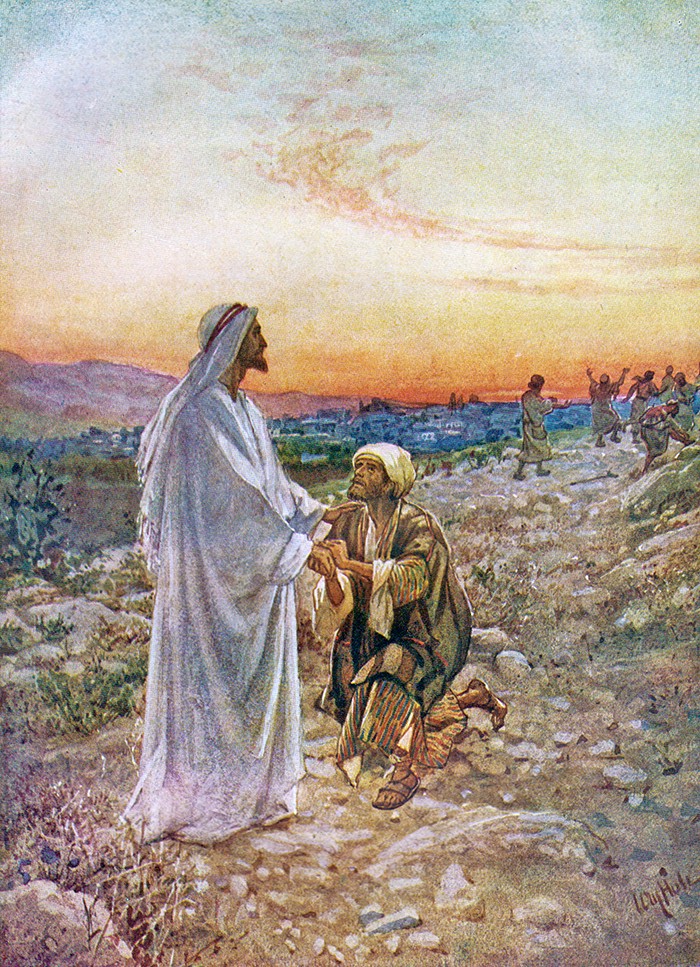
Jesus Heals the Severed Ear of a Servant

When I was about nine years old, I was sitting at the dinner table with my parents, grandparents (Dad’s side), and aunts and uncles. I looked up at my grandfather during the meal as he was eating and noticed something I hadn’t before. He was missing three fingers on his right hand.

I remember whispering to my Dad, “What happened to Grandpa’s hand?” I believe it was later, after dinner, when we were alone, that my Dad explained what had happened. Grandpa had lost his fingers when he tried to retrieve a trowel from an operating concrete mixer. Grandpa’s trowel had fallen in when he was scooping, scraping the machine’s edges. Instead of turning off the engine, Grandpa instinctively tried to grab his trowel. When he did this, the mixer cut three of his fingers off.

I can only imagine the pain, suffering, and thoughts that went through his head when it occurred. “How will I be able to work? How am I going to support my family?”

My grandpa learned to adjust to his injury as he went on to work with my Dad and uncle, who owned their own plastering and drywall business.

In today’s devotion, one of Jesus’ disciples instinctively reacts to his impending arrest.

These Bible passages are set in the Garden of Gethsemane. Jesus has just been betrayed by Judas, and the temple guards are there to arrest Him. The tension in the air was so thick you could cut it with a knife.

Always outspoken and quick to act, Peter decides to take a stand against the authorities who have come to arrest Jesus. Peter draws his sword from its sheath and takes a swing at the High priest’s servant, Malchus. Peter was probably aiming at the servant’s head and thankfully missed, cutting off his ear.

In Luke’s Gospel, Jesus immediately heals Malchus’ ear. Why would He do that?

  • It was the right thing to do, no matter what the circumstances were at that moment.
  • What Peter did was wrong. He attempted to murder someone. Jesus’ healing of Malchus corrects Peter’s angry gesture.
  • In both accounts (Luke and John), Jesus tells Peter and the disciples to stop.

In John’s Gospel, Jesus says, “Put your sword into its sheath; shall I not drink the cup that the Father has given me?”

  • Jesus had a destiny to fulfill. It was to suffer and die. God had given Jesus an assignment, ‘You are the sacrificial lamb for all of mankind.’

Jesus could not and would not allow anything to stand in the way of His destiny as Savior of the world. He must suffer, die, be buried, and rise again from the dead to save us from our sins.

Jesus Withers the Fig Tree

“I was brought up in an environment where a lot of swearing occurred. My family swore quite a bit. As a teen, I worked for my Dad during the summer. He owned a plastering and drywall company. At work, I always seemed to be surrounded by people who cursed. In later years, when I worked in the retail food industry, we also used extremely flowery language. Nineteenth-century author and clergyman Charles Colton said, “Imitation is the highest form of flattery.” I don’t believe that he meant swearing like a sailor in a bar on a Saturday night was something we should imitate.”


“The swearing was, more often than not, not spoken in anger, but as I often say, “We swore like people use the word ‘the.'” Unfortunately, I can also remember many times when I swore in front of people. They would back away and shun me because of my foul language. There were times when curse words did get spoken in anger, and I often paid the price, including getting hit on several occasions because of a verbal outburst on my part.”

Today’s devotion immediately follows Jesus’ cleansing of the temple. On the surface, you might think His cursing of the fig tree was out of anger. Or from frustration from what had occurred in the temple. It’s not.

“In the morning, as he was returning to the city, he became hungry. And seeing a fig tree by the wayside, he went to it and found nothing on it but only leaves. And he said to it, “May no fruit ever come from you again!” And the fig tree withered at once.

When the disciples saw it, they marveled, saying, “How did the fig tree wither at once?” And Jesus answered them, “Truly, I say to you, if you have faith and do not doubt, you will not only do what has been done to the fig tree but even if you say to this mountain. ‘Be taken up and thrown into the sea,’ it will happen. And whatever you ask in prayer, you will receive if you have faith.”

Some fig trees produce figs before their leaves grow out, while others grow figs at the base of the leaves. Either way, the fig tree Jesus encountered was full of leaves but not producing fruit.

He used the tree as an example of the temple and people not producing fruit. Jesus and His disciples had just left the temple, and it (God’s house) was not performing as it should. People were cheating others when exchanging money. Even the temple Priests had the last say about whether or not your animal sacrifice was good enough. They often turned animals away that were “blemish,” free, and suitable for sacrifice. This forced people to purchase animal sacrifices at the temple, which the temple priests received a cut of. The temple was not being used as a house to worship God. It had become a place of sin and profit in many ways.

Jesus also expects us, as Christians, to bear fruit. We are not only to grow in the faith and God’s Word but we are expected to spread the Gospel to others. Jesus also has told us to bear fruit by serving others as He did. (Remember the washing of the disciple’s feet?)

Finally, Jesus tells the disciples and us how powerful prayer is.

Without faith, prayer is an empty gesture. We pray to God the Father and His Son Jesus because we believe. We also believe God created the world. We believe God sent His only Son to save us from sin. We believe that God’s Holy Spirit was sent at Pentecost and enters us through the waters of baptism to be our guide and counselor throughout our lives.

When we pray in faith to Jesus, we tell Him, “I believe,” in (everything I just said in the paragraph above). We believe that He, Jesus, can and will answer our prayers. Perhaps our prayers won’t be answered the way we expect or want. And they may not be answered in the timeline you and I hope for. But rest assured that they will be answered through repentance, faith, and prayer.

Jesus Restores the Sight of Bartimaeus

In 1995, a Christian music group called The KRY released the song “Blind Man” (Show Me the Way).

Below is the first verse and chorus:

In just a few lines, “The Kry” communicated the essence of today’s devotion.

Jesus heals blind Bartimaeus

“And they came to Jericho. And as he was leaving Jericho with his disciples and a great crowd, Bartimaeus, a blind beggar, the son of Timaeus, was sitting by the roadside. And when he heard that it was Jesus of Nazareth, he began to cry out and say, “Jesus, Son of David, have mercy on me!” And many rebuked him, telling him to be silent. But he cried out all the more, “Son of David, have mercy on me!” And Jesus stopped and said, “Call him.” And they called the blind man, saying to him, “Take heart. Get up; he is calling you.” And throwing off his cloak, he sprang up and came to Jesus. And Jesus said to him, “What do you want me to do for you?” And the blind man said to him, “Rabbi, let me recover my sight.” And Jesus said to him, “Go your way; your faith has made you well.” And immediately he recovered his sight and followed him on the way.”

This miracle doesn’t seem much different than any of the others Jesus had performed. But there are one or two points you could easily miss.

Bartimaeus was the first person to be healed by Jesus and to address Him as the ‘Son of David. ‘ Those who knew their Old Testament prophecies understood this title as the title given to the Messiah, the savior of the world.

Jeremiah 23:5-6 is one of the places in the Old Testament where you find a reference to the Messiah coming from the line of David.

When Jesus healed Bartimaeus, He said:

He knew that Bartimaeus understood that He (Jesus) was the promised Messiah. Bartimaeus’ faith in Jesus and who He was allowed him to be healed.

Finally, the last statement of this passage tells us even more about what Bartimaeus was.

Bartimaeus followed Jesus. The passage says that after he received his sight, he followed Jesus as a Christian. The last two words, the way, indicate Bartimaeus’ beliefs and faith.

“The Way” was what modern-day Christianity was called 2000 years ago. Jesus had healed Bartimaeus, and because of his faith, as the song says, He showed him the way home.

Jesus’ Triumphal Entry

Parades are fun to watch. I generally watch Macy’s Thanksgiving parade every year. But my favorite is the parade at Disney World the day after the Super Bowl.

You know the story. After the Superbowl is over, Disney grabs the winning quarterback and says, “Hey _______ (Patrick Mahomes above), you just won the Superbowl. What are you going to do next?” Then the quarterback looks into the camera and says, “I’m going to Disney World.” The very next day, that quarterback is at Disney World on a float, going down Main Street, U.S.A., being cheered by adoring fans.

Jesus was also cheered during a parade on what we call Palm Sunday. But He rode on a donkey towards Jerusalem for a very different reason.

“And when he had said these things, he went on ahead, going up to Jerusalem. When he drew near to Bethphage and Bethany, at the mount that is called Olivet, he sent two of the disciples, saying, “Go into the village in front of you, where on entering you will find a colt tied, on which no one has ever yet sat. Untie it and bring it here. If anyone asks you, ‘Why are you untying it?’ you shall say this: ‘The Lord has need of it.’” So those who were sent went away and found it just as he had told them. And as they were untying the colt, its owners said to them, “Why are you untying the colt?” And they said, “The Lord has need of it.” And they brought it to Jesus and throwing their cloaks on the colt, they set Jesus on it. And as he rode along, they spread their cloaks on the road. As he was drawing near—already on the way down the Mount of Olives—the whole multitude of his disciples began to rejoice and praise God with a loud voice for all the mighty works that they had seen, saying, “Blessed is the King who comes in the name of the Lord! Peace in heaven and glory in the highest!” And some of the Pharisees in the crowd said to him, “Teacher, rebuke your disciples.” He answered, “I tell you, if these were silent, the very stones would cry out.”

And when he drew near and saw the city, he wept over it, saying, “Would that you, even you, had known on this day the things that make for peace! But now, they are hidden from your eyes. For the days will come upon you when your enemies will set up a barricade around you and surround you and hem you in on every side and tear you down to the ground, you and your children within you. And they will not leave one stone upon another in you because you did not know the time of your visitation.”

Allow me to highlight a few points from this passage for you.

  • Jesus’ followers, who were praising Him and welcoming Him as He rode his colt towards the Mount of Olives, fulfilled a prophecy from Zechariah 9:9.

That prophecy was right on the money.

  • The people didn’t understand that Jesus did not come to establish an earthly kingdom.

As we know, He came to die on the cross for everyone’s sins. His sacrifice will open the gates of eternity for everyone.

  • Unfortunately, the people of Jerusalem and the Pharisees were not looking for the Jesus, who brought them love, caring, and peace. They sought a warrior King on a White Steed to lead them to victory over Roman rule.
  • And so, Jesus cried for Jerusalem. He knew what would happen to His beloved city in the not-too-distant future.
  • Jesus’s words, “For the days will come upon you when your enemies will set up a barricade around you and surround you and hem you in on every side and tear you down to the ground, you and your children within you. And they will not leave one stone upon another in you because you did not know the time of your visitation,” were a prophecy.
  • Jesus was describing the Roman siege of Jerusalem in 70 C.E. The city would fall because the people did not recognize who He was and what He was about to do for them. Sacrifice His life so that we may live.

Parades can be fun, like the ones at Disney World. But this parade on that first Palm Sunday was anything but fun. It announced Jesus’ entry into Jerusalem one last time. He was there to fulfill the prophet’s prophesy of a savior and save the world from itself.

Jesus Raises Lazarus from the Dead

As Christians, we generally think of Jesus when we think of someone being raised from the dead. Although I’ve posted and you’ve read devotions about Jesus raising people from the dead, this one is a bit unique.

In the Gospel of Luke 7:11-17, Jesus raises a widow’s son from the dead. In Mark 5:21—24; 35-43, Jesus raised Jairus’s daughter from the dead. In both incidents, Jesus miraculously brought people back to life He did not know intimately. In the case of Lazarus, Jesus raises a friend back from the dead.

There is much to be learned from today’s Bible passage. In it, I will point out just several of the crucial things that were going on in this reading. As this Bible story is quite long, I’ll break up the lesson with my remarks and questions. (In blue)

“Now, a man named Lazarus was sick. He was from Bethany, the village of Mary and her sister Martha. (This Mary, whose brother Lazarus now lay sick, was the same one who poured perfume on the Lord and wiped his feet with her hair.) So, the sisters sent word to Jesus, “Lord, the one you love is sick.”

When he heard this, Jesus said, “This sickness will not end in death. No, it is for God’s glory so that God’s Son may be glorified through it.”

  • If you recognize Mary and Martha’s names, it’s because you’ve read or heard about them before.
  • The Mary referenced in this story is also the same Mary that John mentions in his Gospel, 12:3. She is the Mary who anointed Jesus’ feet with expensive perfume.

Now, Jesus loved Martha and her sister and Lazarus. So, when he heard that Lazarus was sick, he stayed where he was two more days, and then he said to his disciples, “Let us go back to Judea.”

“Agape is the godly love that understands those loved, cares for them, and acts in their favor.” (People’s Bible Commentary, John, Gary P. Baumler, Pp. 160.)

“But Rabbi,” they said, “a short while ago, the Jews there tried to stone you, and yet you are going back?”

Jesus answered, “Are there not twelve hours of daylight? Anyone who walks in the daytime will not stumble, for they see by this world’s light. It is when a person walks at night that they stumble, for they have no light.”

After he had said this, he went on to tell them, “Our friend Lazarus has fallen asleep, but I am going there to wake him up.”

His disciples replied, “Lord, if he sleeps, he will get better.” Jesus had been speaking of his death, but his disciples thought he meant natural sleep.

So, then he told them plainly, “Lazarus is dead, and for your sake, I am glad I was not there so that you may believe. But let us go to him.”

Then Thomas (also known as Didymus (11:16 Thomas (Aramaic) and Didymus (Greek) both mean twin.) said to the rest of the disciples, “Let us also go, that we may die with him.”

  • You’ll notice the disciples warning Jesus not to go back to Judea because the religious leaders wanted to kill Him.
  • Jesus’ answer is a bit abstract, but He’s telling His disciples that His life will not end until the appointed time and not a moment before.
  • When Jesus tells the disciples that Lazarus has merely fallen asleep, they take what He said literally.
  • This moment with the disciple Thomas is much different than the one we know him most for. Here, he shows his faith and asks the rest of the disciples to follow, too, even if it means death.

“On his arrival, Jesus found that Lazarus had already been in the tomb for four days. Now Bethany was less than two miles from Jerusalem, and many Jews had come to Martha and Mary to comfort them in the loss of their brother. When Martha heard that Jesus was coming, she went out to meet him, but Mary stayed at home.

“Lord,” Martha said to Jesus, “if you had been here, my brother would not have died. But I know that even now, God will give you whatever you ask.”

Jesus said to her, “Your brother will rise again.”

Martha answered, “I know he will rise again in the resurrection at the last day.”

Jesus said to her, “I am the resurrection and the life. The one who believes in me will live, even though they die, and whoever lives by believing in me will never die. Do you believe this?”

“Yes, Lord,” she replied, “I believe that you are the Messiah, the Son of God, who is to come into the world.”

  • Martha approaches Jesus and His followers as they are approaching Bethany. She believes that if Jesus had gotten there earlier, her brother Lazarus would still be alive.
  • Martha believes that there is a resurrection after death.

The remarkable proclamation that comes from Martha’s lips is her following words.

  •  “Yes, Lord; I believe that you are the Christ, the Son of God, who is coming into the world.”

“After she had said this, she went back and called her sister Mary aside. “The Teacher is here,” she said, “and is asking for you.” When Mary heard this, she got up quickly and went to him. Now, Jesus had not yet entered the village but was still at the place where Martha had met him. When the Jews who had been with Mary in the house, comforting her, noticed how quickly she got up and went out, they followed her, supposing she was going to the tomb to mourn there.

When Mary reached the place where Jesus was and saw him, she fell at his feet and said, “Lord, if you had been here, my brother would not have died.”

“Come and see Lord,” they replied.

Jesus wept.

Then the Jews said, “See how he loved him!”

But some of them said, “Could not he who opened the eyes of the blind man have kept this man from dying?”

  • Now, Martha’s sister Mary comes to Jesus and reiterates her sister’s words.
  • When Jesus saw how she and the other woman were weeping, He wept too.
  • He was not wailing and carrying on. In Greek, His weeping is different. A tear or two comes from His eye, running down His cheek. Was Jesus crying for His friend Lazarus? Yes. And, perhaps, there was a tear for those who didn’t believe. And, because they didn’t have faith, they would suffer eternal death. Perhaps there was a tear for what was about to happen because it mirrored His upcoming death and resurrection.

“But, Lord,” said Martha, the sister of the dead man, “by this time, there is a bad odor, for he has been there four days.”

So, they took away the stone. Then Jesus looked up and said, “Father, I thank you that you have heard me. I knew that you always hear me, but I said this for the benefit of the people standing here, that they may believe that you sent me.”

When he had said this, Jesus called in a loud voice, “Lazarus, come out!” The dead man came out, his hands and feet wrapped with strips of linen and a cloth around his face.

Jesus said to them, “Take off the grave clothes and let him go.”

  • Martha’s reaction is interesting when Jesus tells people to “Take away the stone.” 
  • Jesus is known for performing miracles, including raising people from the dead.
  • She is more concerned about Lazarus’ body condition and the decaying smell.
  • Like me, I’m sure you’ve watched plenty of crime shows. Often, there’s a scene when two detectives enter a home or apartment. When they walk into the dwelling, they look at each other, and inevitably, one of them says, “Do you smell that?’
  • But Jesus was not concerned about this at all.

Perhaps He had miraculously caused the body not to decay in advance. Or, when He told people to remove the stone and said, “Lazarus, come out,” Lazarus’ body was restored; thus, there was no smell.

  • Finally, Jesus gives instructions to take the burial clothes off Lazarus and let him go.
  • Jesus’s death was coming soon, but His death was temporary.

Jesus Heals Ten Men of Leprosy

Leprosy (Hansen’s disease) is a chronic, curable infectious disease, mainly causing skin lesions and nerve damage.

Leprosy is caused by infection with the bacterium Mycobacterium leprae. It mainly affects the skin, eyes, nose, and peripheral nerves.

Symptoms include light-colored or red skin patches with reduced sensation, numbness, and weakness in hands and feet.

Leprosy can be cured with 6-12 months of multi-drug therapy. Early treatment avoids disability.

But wait, there’s more!

Very rare

Fewer than 20,000 US cases per year

Treatable by a medical professional

Requires a medical diagnosis

Lab tests or imaging are often required

Chronic: can last for years or be lifelong

(CDC.org)

Let’s look at Jesus healing ten men of Leprosy.

 “As Jesus continued on toward Jerusalem, he reached the border between Galilee and Samaria. As he entered a village there, ten men with Leprosy stood at a distance, crying out, “Jesus, Master, have mercy on us!”

He looked at them and said, “Go show yourselves to the priests.” And as they went, they were cleansed of their Leprosy.

One of them, when he saw that he was healed, came back to Jesus, shouting, “Praise God!” He fell to the ground at Jesus’ feet, thanking him for what he had done. This man was a Samaritan.

Jesus asked, “Didn’t I heal ten men? Where are the other nine? Has no one returned to give glory to God except this foreigner?” And Jesus said to the man, “Stand up and go. Your faith has healed you.”

In Jesus’ time, people with Leprosy were shunned and made to live in colonies outside of the main cities. At that time, it was incurable, and you would eventually die from the disease.

Because of their disease, lepers were considered unclean. Only after being declared clean by a priest could a leper re-enter society once again.

Okay. That’s your history lesson for the day. I think it’s essential that you know what disease Jesus cured.

Whether it was the one or ten lepers, everyone, including the disciples, probably would have backed away from the leper(s). So, for Jesus to come close to them, let alone touch them, was unthinkable.

We know from the story in Luke 5 that Jesus had cleaned a man of Leprosy earlier in His ministry. This one man who was healed was probably a Jew. In this second healing of Leprosy, Jesus heals not one but ten men who ask for mercy (pity).

So, Jesus sent them to the priests, and all ten were healed while they were traveling.

We find out in the reading that one of the lepers is a Samaritan, a foreigner. It is presumed that the other nine lepers are Jews.

(A little Samaritan background)

Jews generally looked upon Samaritans as “ethnic and religious half-breeds.” (Serendipity Bible)

The Samaritans were half-Jew and half-Gentile. The race came about after the Assyrian captivity of the northern kingdom of Israel in 721 B.C. Certain people from the nation of Israel stayed behind. These people intermarried with the Assyrians, producing the Samaritans. They had no dealings with Jews.

In Luke 9, a Samaritan Village did not welcome Jesus and His disciples. Yet, one chapter later, Jesus tells the story of the Good Samaritan. In John 4, Jesus talks to the Woman at the well. She is a Samaritan, and after speaking to Him, she comes to faith in Christ. In our reading of the ten lepers, the one who comes back to Jesus and gives thanks is a Samaritan.

Jesus wants us to understand that the message of the Gospel goes beyond racial barriers; it breaks them down. The Gospel of Jesus Christ is for everyone.

Our job as Christians is to “Go and make disciples of all nations.” (Matthew 28). It seems like it should be easy for us to do that. The church sends missionaries worldwide to do just that and spread the news of Jesus Christ.

It seems much more difficult for many people (yes, even Americans) to bring and share the love of Christ’s Gospel with our neighbors. The neighbors and people we encounter daily who speak a different language have a different skin color, values, or customs than we do.

A lone Samaritan leper comes back to Jesus and says, thank you. The nine Jews don’t. Everyone needs to know the love that Jesus offers, no matter who or where they come from. We can give this message to others, not just through God’s Word but also through our actions.

Finally, always follow Jesus’ final command:

Jesus Heals a Man with Dropsy

The Gospels speak of many ailments. We’ve read of Jesus’ healings of blindness, deafness, leprosy, bleeding, and demon possession. In today’s reading from Luke, Jesus heals a man of dropsy.

Today, we no longer call the ailment the man had dropsy; now, it’s referred to as Edema. Edema is a condition characterized by an excess of watery fluid collecting in the body’s cavities or tissues. Usually, this illness is connected with congestive heart failure, as well as liver or kidney failure.

“One Sabbath, when he went to dine at the house of a ruler of the Pharisees, they were watching him carefully. And behold, there was a man before him who had dropsy. And Jesus responded to the lawyers and Pharisees, saying, “Is it lawful to heal on the Sabbath, or not?” But they remained silent. Then he took him and healed him and sent him away. And he said to them, “Which of you, having a son or an ox that has fallen into a well on a Sabbath day, will not immediately pull him out?” And they could not reply to these things.”

One has to wonder why a person with dropsy was at the home of a Pharisee. The passage notes that Jesus was being carefully watched. Perhaps the Pharisees invited the ailing man to see if Jesus would heal him on the Sabbath. This would then result in Jesus being trapped and accused of not following the Sabbatical rules.

In his case, before healing the man of dropsy, Jesus asks the Pharisees and experts of the law a question:

“Jesus asked the Pharisees and experts in the law, “Is it lawful to heal on the Sabbath or not?” Luke 14:3

When Jesus healed the woman, who had been crippled for 18 years, He did not ask. He simply healed her.

“When Jesus saw her, he called her forward and said to her, “Woman, you are set free from your infirmity.” Then he put his hands on her, and immediately she straightened up and praised God.” Luke 13:12-13

If we look back at the miracle of Jesus healing the man with a withered hand, He asked the synagogue members a question.

“Then Jesus said to them, “I ask you, which is lawful on the Sabbath: to do good or to do evil, to save life or to destroy it?” Luke 6:9

When Jesus asked a question about what was lawful on the Sabbath, He never asked permission. Jesus was putting the religious leaders on the spot. Nevertheless, in each case, He always healed the ailing person.

In today’s devotion, Jesus has a follow-up question that speaks to the heart of the matter concerning the Sabbath.

Jesus was trying to tell the religious leaders that love comes first. The Pharisees and religious leaders were concerned about following the letter of the law. Jesus emphasized that people’s well-being is more important than following the Sabbatical law to the letter.

I’m not saying we shouldn’t follow the commandments or rules. The regulations and laws are put in place for a reason. But, at the same time, we must put the well-being of others first.

Jesus said:

Serve others as Jesus did, and always put God and your neighbor’s best interests first.

Jesus Heals a Woman with a Disabling Spirit

We’ve all heard many children’s nursery rhymes in our lives. I always found the nursery rhyme about the crooked man sad.

There are a variety of interpretations of this nursery rhyme. When I hear it, I think of the many people I’ve seen throughout my life with a crooked body.

I’ve known several people who have had scoliosis, a curvature of the spine. One wore a large brace from their neck to their waist during all their waking hours for over 5 years.

I have seen many older folks bent over and twisted during my lifetime. Somehow, they persevere and continue life, even though they walk and move in what must be an uncomfortable position.

In today’s devotion, Jesus encounters a woman who has been crippled and bent over for 18 years.

“Now he was teaching in one of the synagogues on the Sabbath. And behold, there was a woman who had had a disabling spirit for eighteen years. She was bent over and could not fully straighten herself. When Jesus saw her, he called her over and said to her, “Woman, you are freed from your disability.” And he laid his hands on her, and immediately she was made straight, and she glorified God. But the ruler of the synagogue, indignant because Jesus had healed on the Sabbath, said to the people, “There are six days in which work ought to be done. Come on those days and be healed, and not on the Sabbath day.” Then the Lord answered him, “You hypocrites! Does not each of you on the Sabbath untie his ox or his donkey from the manger and lead it away to water it? And ought not this woman, a daughter of Abraham whom Satan bound for eighteen years, be loosed from this bond on the Sabbath day?” As he said these things, all his adversaries were put to shame, and all the people rejoiced at all the glorious things that were done by him.”

This miracle happens rather quickly. Jesus is teaching in the synagogue on the Sabbath (Saturday). He sees the crippled woman, calls her over, touches her, and says, “Woman, you are freed from your disability.” 

The woman is instantly healed after being disabled for many years.

The story’s real point is not the healing (although all miracles and healings Jesus did and does are significant). Instead, it is about what is permissible to do on the Sabbath.

The Levitical laws and those enacted by the teachers of the law were stringent. Basically, you were not allowed to do anything work-related on the Sabbath.

This particular synagogue leader is not happy with Jesus, not just because he performed a miracle but also because he got upstaged by Him. The ruler then doesn’t even have the decency to speak directly to Jesus. Instead, he chastises the people gathered in the synagogue for allowing themselves to be healed on the Sabbath.

Jesus has no stomach for this ruler. What Jesus says next would be considered righteous anger.

The idea here is that it’s okay for religious leaders to feed and water their animals on the Sabbath. But Jesus can’t heal a woman who has been suffering for eighteen years?

The religious leaders broke the stringent points of the Sabbath as much as anyone. How can anyone say you shouldn’t minister to others on the Sabbath?

You’ll notice Jesus never says that the woman in this story is demon-possessed, but He does say that Satan caused the ailment. Can you imagine the joy the now-healed woman and her family felt after all her years of suffering?

When I moved to Florida in the late ’70s, many businesses were closed on Sundays. Publix supermarkets and many other shops were closed. It was always challenging to find an open gas station. Unfortunately, things have changed, and people have forgotten what the Sabbath is for.

The Sabbath (our Sunday) is a time of renewal. Unfortunately, many people must work on Sundays and cannot attend worship services. So, why not observe the Sabbath on Monday, Tuesday, or any other day of the week? We should rest when we observe the Sabbath, as God did after His six days of creation. The Sabbath is a time of spiritual renewal, a time to get in touch with God personally and with our family. Commit time each week to Sabbath.

Jesus VS. Beelzebub

In 1858, Abraham Lincoln accepted the nomination for senator from the republican party of Illinois. He ran against Stephen Douglas, the incumbent. The two had nine debates throughout Illinois during the fall of that year. Douglas won the election, but Lincoln gained popularity around the county. He became so popular that he ended up in the White House two years later.

Here’s a portion of one of Lincoln’s debate speeches from 1858. The Lincoln animatronic at the Hall of Presidents in Walt Disney World uses parts of this speech.

Lincoln delivered one of his most famous speeches, the “House Divided” Speech. In it, he addressed the burning issue of slavery.

 Living on the other side of history, we know that Lincoln’s speech was quite prophetic. A Civil War would begin in our country in just three years.

 His house-divided statement was borrowed from the Bible; specifically, they are the words of Jesus.

The miracle for today’s devotion is Jesus healing a demon-possessed man. The healing itself is only one verse long.


“Then a demon-oppressed man who was blind and mute was brought to him, and he healed him so that the man spoke and saw.” V. 22

What the crowd said as a result of the miracle was filled with praise.

“And all the people were amazed and said, “Can this be the Son of David?”  V. 23

What the Pharisees thought was condemnation.

But when the Pharisees heard it, they said, “It is only by Beelzebub, the prince of demons, that this man casts out demons.” V. 24

Jesus’ reply to the Pharisees was and is common sense.

 “Knowing their thoughts, he said to them, “Every kingdom divided against itself is laid waste, and no city or house divided against itself will stand. And if Satan casts out Satan, he is divided against himself. How then, will his kingdom stand? And if I cast out demons by Beelzebub, by whom do your sons cast them out? Therefore, they will be your judges. But if it is by the Spirit of God that I cast out demons, then the kingdom of God has come upon you.”

The Pharisees were accusing Jesus of being Satan or Beelzebub (which literally means Lord of the Flies.)

This accusation makes no sense, according to Jesus. If He were Satan, He wouldn’t be casting out Satan. We’ve just covered a small number of Jesus’ miracles. But, on more than one occasion, we’ve read that Jesus healed numerous people of ailments and cast out demons.

Would Satan cast the legion of his demons into a herd of pigs? Of course not. Beelzebub is not going to destroy his own army.

So, if that isn’t happening, then what is? Jesus says, But, if it is by the Spirit of God that I cast out demons, then the kingdom of God has come upon you.”

Jesus is telling the people and the Pharisees that He is casting out demons by the Spirit of God. Jesus is replying in the affirmative to the people’s question.

“And all the people were amazed and said, “Can this be the Son of David?” 

Yes, Pharisees, yes, people, it is He. This is Jesus, the Son of David, the Son of the living God.

Christ died to rid us of the sin that was imprinted on our hearts and souls. He freed us from Satan’s grasp through His death on the cross and resurrection three days later.

At times, our world may seem divided against itself. But, because of Jesus’ sacrifice, we will never be separated from Him.

Dear Lord. Thank you for sending your Son, Jesus, to us. His sacrifice and your love have freed us from Satan’s grasp. We live because your Son died for us. Thank you for your unending Grace. Amen.

Jesus Pays the Temple Tax

(The fishing story below is borrowed from my book, “Adventures in Youth Ministry.”

When I was about 10 or 11 years old, I lived in Chicago. Once in a while, my Dad would take me fishing to Montrose Beach on Lake Michigan. I would use a fishing pole and cast with a worm on a hook.

But my Dad would troll fish. He’d take this small anchor attached to a long rope, swing it over his head, and throw it into the lake. Next, my Dad attached a metal pulley to the rope with a long line connected to it. The pulley system also had fish hooks on it. Dad would bait the hooks and slowly let the line down in the water. The entire contraption was attached to a metal pole about six or seven feet tall that he would stick into the sand. A small bell was tied to the rope at the top of the pole. If a fish would “hit” one of the hooks, the bell would ring, and then slowly, he’d pull the pulley line in. But guess what? He rarely would catch any fish that way. Come to think about it, neither did I.😊

The Gospels are full of fish stories. Some are about catching fish; others are about not catching fish. There’s even a story about Jesus telling his future disciples to follow Him, and He would make them fishers of men.

Today’s devotion is yet another fish story. This one is about paying the temple tax with coins found in a fish’s mouth.

“When they came to Capernaum, the collectors of the two-drachma tax went up to Peter and said, “Does your teacher not pay the tax?” He said, “Yes.” And when he came into the house, Jesus spoke to him first, saying, “What do you think, Simon? From whom do kings of the earth take toll or tax? From their sons or from others?” And when he said, “From others,” Jesus said to him, “Then the sons are free. However, not to give offense to them, go to the sea and cast a hook and take the first fish that comes up, and when you open its mouth, you will find a shekel. Take that and give it to them for me and for yourself.”

Jesus and His disciples are back in Capernaum. This was Jesus’ home base during His earthly ministry, and it was literally Peter’s hometown. So, it’s not unusual for the tax collectors to approach Peter. Perhaps Jesus and the disciples had been gone for a long time, so when the temple tax collector realized they were back in town, they approached Peter.

This two-drachma tax was collected yearly from all Jews to help maintain the temple. Two-drachma was equal to one day’s wage.

When Peter told the tax collectors that Jesus did pay the tax, we can assume he had been with Him when He had paid the tax in the past.

So Peter goes to the house where they are staying. As usual, the all-knowing (omniscient) Jesus already knows what Peter will say. When He asks Peter whether Kings make their sons pay taxes, He refers to Himself.

The temple is God’s house. Jesus is the Son of God. So, Jesus was begging the question, ‘If I’m the Son of God, why should I be asked to pay the tax?’

But Jesus doesn’t want to make a big deal about the tax. If He did, it would draw unnecessary attention to Himself. Also, if Jesus fought paying the tax, it would put Him in a bad light. He would appear not to care about the temple. In addition, we already know that Jesus would be there soon enough, turning over the money-changers tables in righteous anger.

Finally, instead of pulling the coins out of His pocket, Jesus tells Peter to go fishing. He specifically tells him to use a hook, not a net. Peter only needs to catch one fish, and in the mouth of that one fish will be one coin, a shekel. A shekel is the amount necessary to pay the temple tax for two people, Jesus and Peter.

It seems to be a rather strange passage, doesn’t it? The story is partly about a miracle, but we never see one, do we? We, as Christians, must make the presumption that Peter followed through on Jesus’ instructions.

We need to have faith that Peter went to the shore and went fishing with a simple pole, line, and hook. Peter caught the fish, found the coin, and paid the tax.

One might say, “Don’t you think Peter thought this was crazy and might have hesitated to go fishing for a fish with a coin in its mouth?” The answer to that question lies in another passage from Matthew.

 “So, Peter got out of the boat and walked on the water and came to Jesus. But when he saw the wind, he was afraid and beginning to sink; he cried out, “Lord, save me.” Jesus immediately reached out his hand and took hold of him, saying to him, “O you of little faith, why did you doubt?” 

When Peter’s faith weakened because of his fear of the waves and wind, he sank into the water. One would hope and pray that Peter had learned his lesson and would follow Jesus’ words exactly.

Jesus’ instructions to us are the same. Sometimes, He will lead us or tell us to do something that seems strange or impossible. It’s our responsibility as His followers to listen and follow. Jesus knows precisely what He’s doing and exactly what the end result will be.