
The Parable of the Ten Minas

Lenten Devotions

A Walk Through the Book of Luke

Luke 19: 11-27

April 4, 2023

The Parable of the Ten Minas

(I need to begin with an explanation. For those of you who regularly read my devotions, you probably noticed I didn’t post one yesterday. My wife, who had been in the hospital and rehab, came home yesterday. She is my priority when it comes to my writing. I pray you understand.) Joe G.

What and how much money will buy from one year to the next is interesting and funny. I was born in 1951. When I was a youngster in the 1950s, a two-pack of Twinkies was only 10 cents; today, it’s $1.99.

A pack of chewing gum was 5 cents. Today, depending on where you purchase it, a pack of gum can cost over $1. When I first began going to the movie theater with friends, around 1960-61, if you were under the age of 12, it cost 25-50 cents to enter. Today, we spend anywhere from $8 to $11 per person, sometimes more if it’s a 3D movie. That’s to watch one movie.

Back in the 1960s, for that aforementioned 25-50 cents, you would watch two movies and cartoons during the intermission. Finally, here’s one that will hit home. Gas was 19 cents a gallon. As of today, at the station I frequent, the cost is $3.49 a gallon.

Putting this all into perspective, one has to also know that the average weekly wage in 1960 was just $60.

In today’s parable, a Mina that Jesus talks about is worth three months in wages. So keep that in mind as you read today’s devotion.

******************************The Point**************************

Let’s take a few minutes to read today’s parable. What do you believe a mina really is in today’s story?

“While they were listening to this, he went on to tell them a parable because he was near Jerusalem, and the people thought that the kingdom of God was going to appear at once. He said: “A man of noble birth went to a distant country to have himself appointed king and then to return. So, he called ten of his servants and gave them ten minas. (19:13 A mina was about three months’ wages.) ‘Put this money to work,’ he said, ‘until I come back.’

 “But his subjects hated him and sent a delegation after him to say, ‘We don’t want this man to be our king.’

 “He was made king, however, and returned home. Then he sent for the servants to whom he had given the money in order to find out what they had gained with it.

 “The first one came and said, ‘Sir, your mina has earned ten more.’

 “‘Well done, my good servant!’ his master replied. ‘Because you have been trustworthy in a very small matter, take charge of ten cities.’

 “The second came and said, ‘Sir, your mina has earned five more.’

 “His master answered, ‘You take charge of five cities.’

 “Then another servant came and said, ‘Sir, here is your Mina; I have kept it laid away in a piece of cloth. I was afraid of you because you are a hard man. You take out what you did not put in and reap what you did not sow.’

 “His master replied, ‘I will judge you by your own words, you wicked servant! You knew, did you, that I am a hard man, taking out what I did not put in and reaping what I did not sow? Why then didn’t you put my money on deposit so that when I came back, I could have collected it with interest?’

 “Then he said to those standing by, ‘Take his mina away from him and give it to the one who has ten minas.’

 “‘Sir,’ they said, ‘he already has ten!’

 “He replied, ‘I tell you that to everyone who has, more will be given, but as for the one who has nothing, even what they have will be taken away. But, those enemies of mine who did not want me to be king over them—bring them here and kill them in front of me.'”

The long and short of this parable is that Jesus told, is to correct the expectations of His followers. They believed that a worldly revolution would soon establish Christ’s Kingdom here on earth. He points out the rejection of the nobleman who rejected the idea he should be made king.

Jesus himself was soon to be rejected. Like the nobleman in the parable, there would be a time when Jesus would be away (today, we still await His triumphant return.)

The nobleman gave each ten servants a mina to “put to work” to increase his wealth. Jesus expects (us) His followers, to take His teachings and bring them to the world. Thus, increasing those who believe and are saved.

There will be a time when Jesus does return. Those who have done what He charged us with, “Go and make disciples of all nations,” will be rewarded with salvation. Those who do not will be punished and receive eternal punishment, much like the servant who did nothing with the Mina, he was given.

I began this devotion by discussing how much things cost 60 years ago. First, I mentioned how much several items like gum and gas cost then and now.

But, these are worldly items, gas, gum, and Twinkies, that I spoke of. Our salvation is not about this world; it is about eternity.

Our hope of eternal life is wrapped up in Jesus’ final word to His disciples in the book of Matthew.

“Then the eleven disciples went to Galilee, to the mountain where Jesus had told them to go. When they saw him, they worshiped him; but some doubted. Then Jesus came to them and said, “All authority in heaven and on earth has been given to me. Therefore, go and make disciples of all nations, baptizing them in the name of the Father and of the Son and of the Holy Spirit, and teaching them to obey everything I have commanded you. And surely, I am with you always, to the very end of the age.” Matthew 28:16-20

Christ has not returned yet. When He does, and you and I stand before Him, what will we have done with the Mina (Gospel Message) He gave us. Will we have made it grow or just buried it?
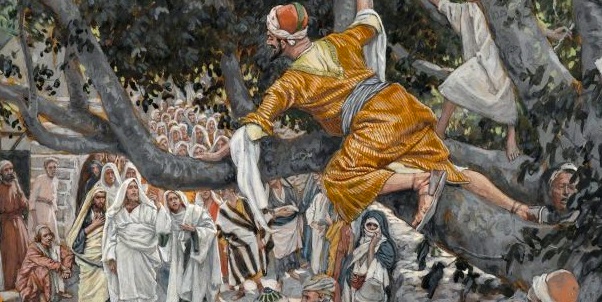
Zacchaeus, the Tax Collector

Lenten Devotions

A Walk through the Book of Luke

Luke 19: 1-10

Zacchaeus, the Tax Collector

Here’s an Old English poem by Francis Quarles that addresses Zacchaeus’ reaction to Jesus calling him down from the tree.

 It’s written in Old English, but I believe you’ll understand the gist of it.

On Zacchaeus

by Francis Quarles

Methinks I see, with what a busy haste 
Zacchaeus climbed the tree. But oh, how fast, 
How full of speed, canst thou imagine, when 
Our Savior called; he powdered down again! 
He ne’er made trial if the boughs were sound 
Or rotten, nor how far ’twas to the ground. 
There was no danger feared: at such a call, 
He’ll venture nothing that dare fear a fall. 
Needs must he down, by such a spirit driven; 
Nor could he fall unless he fell to heaven. 
Down came Zacchaeus ravished from the tree: 
Bird that was shot ne’er dropped so quick as he.

******************************The Point****************************

In today’s story, we find Zacchaeus up in the Sycamore tree. Jesus sees him and tells him to come down because He wants to stay at his home.

***************************

“Jesus entered Jericho and was passing through. A man was there by the name of Zacchaeus; he was a chief tax collector and was wealthy. He wanted to see who Jesus was, but because he was short, he could not see over the crowd. So, he ran ahead and climbed a sycamore-fig tree to see him since Jesus was coming that way.

When Jesus reached the spot, he looked up and said to him, “Zacchaeus, come down immediately. I must stay at your house today.” So, he came down at once and welcomed him gladly.

All the people saw this and began to mutter, “He has gone to be the guest of a sinner.”

But Zacchaeus stood up and said to the Lord, “Look, Lord! Here and now, I give half of my possessions to the poor, and if I have cheated anybody out of anything, I will pay back four times the amount.”

Jesus said to him, “Today, salvation has come to this house because this man, too, is a son of Abraham. For the Son of Man came to seek and to save the lost.” Luke 19:1-10

So, Jesus goes to Zacchaeus’ home. Then something surprising happens. This wealthy tax collector that the people despised stands up. He tells Jesus, and everyone present that he was giving half his possessions to the poor. He also states that he would reimburse anyone he’s ever cheated (He must have kept some detailed books). Additionally, Zacchaeus announces that he would repay four times the amount of money he had defrauded from people.

Talk about a “Come to Jesus moment!”

Then Jesus announces, “That salvation has come to this house.”

The best way to understand Jesus’ reaction to what Zacchaeus said and did, is to look back at Luke 18:18-29.

The Rich Young Ruler

“A certain ruler asked him, “Good teacher, what must I do to inherit eternal life?”

 “Why do you call me good?” Jesus answered. “No one is good—except God alone. You know the commandments: ‘You shall not commit adultery, you shall not murder, you shall not steal, you shall not give false testimony, honor your father and mother.'”

“All these I have kept since I was a boy,” he said.

When Jesus heard this, he said to him, “You still lack one thing. Sell everything you have and give to the poor, and you will have treasure in heaven. Then come, follow me.”

When he heard this, he became very sad because he was very wealthy.

 Jesus looked at him and said, “How hard it is for the rich to enter the kingdom of God! Indeed, it is easier for a camel to go through the eye of a needle than for someone who is rich to enter the kingdom of God.”

Those who heard this asked, “Who then can be saved?”

Jesus replied, “What is impossible with man is possible with God.” Luke 18:18-27

There are notable differences between the rich young ruler and Zacchaeus. First, the rich young ruler was unwilling to give up his money, possessions and give to the poor to follow Jesus.

 Zacchaeus’ attitude was the exact opposite of the young rulers.

“But Zacchaeus stood up and said to the Lord, “Look, Lord! Here and now, I give half of my possessions to the poor, and if I have cheated anybody out of anything, I will pay back four times the amount.”

Zacchaeus cleaned up his act, didn’t he? He chose the correct path. He was willing to give up most of his riches, right any wrongs he had done financially, and give to the poor.

Zacchaeus understood what Jesus was all about. He was willing to give up his earthly wealth and give to the poor because his salvation was more important than money.


How about you? How well do you share your riches with others?

Who are you more like Zacchaeus or the rich young ruler?

Before you answer that question, ponder Jesus’ words at the end of today’s reading.

“Today salvation has come to this house because this man, too, is a son of Abraham. For the Son of Man came to seek and to save the lost.”

We all have a choice. What will yours be?

Let the little children come to Me!

Lenten Devotions

A Walk through the Book of Luke

April 1, 2023

Matthew 9:13-15; Luke 18:15-17

“Let the little children come to Me!”

(Time once again to take a break from parables. The story of Jesus with the little children is one of my favorites. Although this is not a parable, the passage is one for young and old alike.)

While in full-time ministry, preparing and sharing children’s messages was one of my favorite parts of my week. When I called the children up to the front of the church during the Sunday worship service, many of them did so with wide-eyed wonder. Perhaps the same wide-eyed wonder that many adults who stopped to listen to Jesus had.

I pray you never stop being wide-eyed and full of wonder each time you think about Jesus as your Lord and Savior.

***************************The Point**************************

You’ll find this story in both the book of Matthew and Luke. For today’s devotion, I chose Matthew’s version.

“Then, people brought little children to Jesus for him to place his hands on them and pray for them. But the disciples rebuked them.

Jesus said, “Let the little children come to me, and do not hinder them, for the kingdom of heaven belongs to such as these.” When he had placed his hands on them, he went on from there.” Matthew 19:13-15

There’s nothing quite like a kind or loving touch from another person, is there?

A boy and girl or man and woman holding hands as they walk through the mall. People are holding hands as they pray at the dinner table, a hug from your child or grandchild, or touching the one you love on the cheek as you look into their eyes.

Jesus was a loving, touching person. He touched people, and they were healed. The blind man and the woman who touched His robe were healed, and He touched His disciple’s feet as He washed them, showing them how to serve one another.

In today’s verses, parents were looking for Jesus to touch their children and to pray for them. It doesn’t say why they wanted Him to touch them, but it can be presumed it was for a blessing and general healing. (Luke’s Gospel says explicitly that the children were babies.)

Yet the disciples tried to send these families away until Jesus intervened and rebuked them. He made it a teaching moment that went beyond touching.

Jesus said, “Let the little children come to me and do not hinder them, for to such belongs the kingdom of heaven.

First of all, Jesus admonishes His disciples when He says,

“Let the children come to me and do not hinder them.”

Yes, they are children, but don’t you ever stop them from coming to me. Second, He says,

“For to such belongs the kingdom of heaven.”

What is Jesus talking about in the statement above? It’s this. There is only one required standard to enter the kingdom of heaven: having childlike Faith in Christ.

Children don’t have what we do have, and we need not have to enter the kingdom. Now there’s a sentence for you. 😊

You see, children are meek; they don’t have malice, they have no pride, and they aren’t ambitious. Children don’t care about how much money you make, and don’t judge people. On the contrary, they care about others better than most adults, and in their eyes, everyone is their friend.

God wants us to get rid of all our stinginess, jealousy, and malice we may have towards others and instead possess that innocent, childlike Faith of a little child. God wants our unconditional love. He wants us to believe in what His Son Jesus accomplished by dying on the cross. And, He wants us to serve all of humankind.

Sounds easy, doesn’t it? Of course, we all know that is not true. Yet we should strive for it every day to love Jesus with all of our heart, mind, and soul, like that of a little child.

I wrote a closing prayer several years ago that fits this devotion.

Dear Lord, help us keep our minds and hearts open and innocent as a child’s.

We want to love you unconditionally and believe in your Son Jesus and what he did on the cross for us.

But, sometimes, our Faith is weak. Help our Faith in you, your Son, and the Holy Spirit grow daily. Help us to be closer to you and have Faith, so we can live with you in eternity.

Amen

The Parable of the Pharisee and the Tax Collector

Lenten Devotions

A Walk through the Book of Luke

March 31, 2023

Luke 18:9-14

The Parable of the Pharisee and the Tax Collector

“Rich or poor, greaser or jock. All are welcome.”

When I attended high school in the late 1960s, groups of students were identified by particular names. We still had the “Greasers” (Think of Danny Zuko in the movie Grease). Then, there were the jocks, who were athletes, and I guess you could also put the cheerleaders in that category too.

There was also a group that included all the really smart kids. I don’t recall what their tag was, but I’ll just call them the Brainiacs. And then there was me; I guess you would have called me a nerd.

Today we still have “Class,” grouping, and rankings in our society. There is low income or people experiencing poverty. Then there is a group I would be a part of, the middle class. And, of course, there are the people in the upper one percent of our society. They are called the upper class.

Most of these class determinations are made by how much money people make, their jobs, and their lifestyle.

In today’s parable, we will see two different classes represented by two men as they pray.

*************************The Point***********************

Jesus’ parable tells about a most likely wealthy Pharisee and a tax collector who was generally despised and looked down upon.

“To some who were confident of their own righteousness and looked down on everyone else, Jesus told this parable: “Two men went up to the temple to pray, one a Pharisee and the other a tax collector. The Pharisee stood by himself and prayed: ‘God, I thank you that I am not like other people—robbers, evildoers, adulterers—or even like this tax collector. I fast twice a week and give a tenth of all I get.’

“But the tax collector stood at a distance. He would not even look up to heaven but beat his breast and said, ‘God, have mercy on me, a sinner.’

“I tell you that this man, rather than the other, went home justified before God. For all those who exalt themselves will be humbled, and those who humble themselves will be exalted.” Luke 18:9-14

Did you notice the difference between the two prayers in the parable? The Pharisee prayed about how great he was. He touted to God how large his weekly tithe was and how he fasted twice weekly. (It makes you wonder why he even bothered praying because his prayer was all about himself.)

On the other hand, the tax collector stood far away from the holy place in the temple. He bowed his head and didn’t raise his hands to the Lord as the Pharisee did. Instead, he confessed his sinfulness and asked God to have mercy on him.

“Jesus renders His verdict: the tax collector rather than the Pharisee is justified before God.” (People’s Bible Commentary, Luke, Victor H. Prange, Pp. 198.)

The Pharisee was far from being right with God. All he did in his prayer was to point out his good points and how great he was compared to the tax collector.

In God’s judgment, the tax collector is the one who is right with God. Why? Because of his confession and his faith that God was a merciful God.

“God reverses human thinking and evaluation: God humbles the exalted and exalts the humble. This is God’s kind of justice.” (Peoples Bible Commentary, Luke, Victor H. Prange, Pp. 198)

Rich, poor, or middle class. Greaser or Jock. It doesn’t matter what or who you are, as long as you have faith in Jesus and repent of your sins. Only then are you righteous in the eyes of God. Not because of what you do but because of what He did and accomplished. He (God) sent His Son Jesus to live on earth and die on the cross for our sins.

Being Persistent in Prayer

Lenten Devotions

A Walk through the Book of Luke

March 30, 2023

Luke 18:1-8

The Parable of the Persistent Widow

“Being persistent in Prayer.”

At the time of this writing, my wife has been in the hospital for eight days now. She has double pneumonia, blood clots in her lungs, a persistent dry cough, and a low-grade fever that comes and goes. And, as many of you know, she has progressive M.S.

To say that I have been persistent in my prayers for her would be an understatement. Hopefully, that is why she has improved some. Once the doctors stabilize her blood oxygen, she’ll be moved to a rehab center for a couple of weeks to help regain her strength.

Prayer requests to God are not necessarily met with an immediate answer. All prayers are answered in God’s time, not ours. And the thing that frustrates people the most is that God’s answers to our prayers are often not what we expect. He answers our prayers in ways that many times seem unusual or insufficient. But, He does answer them.

Today’s parable is about a persistent widow.

**********************The Point*********************

The most interesting part of this parable is that Jesus tells His disciples what it’s about before He shares it with them.

“Then Jesus told his disciples a parable to show them that they should always pray and not give up. He said: “In a certain town, there was a judge who neither feared God nor cared what people thought. And there was a widow in that town who kept coming to him with the plea, ‘Grant me justice against my adversary.’

 “For some time, he refused. But finally, he said to himself, ‘Even though I don’t fear God or care what people think, yet because this widow keeps bothering me, I will see that she gets justice so that she won’t eventually come and attack me!’”

And the Lord said, “Listen to what the unjust judge says. And will not God bring about justice for his chosen ones, who cry out to him day and night? Will he keep putting them off? I tell you, he will see that they get justice and quickly. However, when the Son of Man comes, will he find faith on the earth?”

Luke 18:1-8

Jesus tells this parable to His disciples to encourage them to be persistent with their prayers because the Father is listening.

The woman in today’s parable has only one way to get the outcome she seeks. She is persistent in going to the judge over and over again. Finally, she wears him down, and he gives her the outcome she asks for.

I don’t believe we can wear God down by being persistent in our prayers. On the contrary, by not answering our prayers immediately, God tells us,

“I hear you, be patient.”

There are times in our lives our faith can dwindle. It can be because of the loss of a loved one, loss of a job, or wondering why a woman who already has M.S. is going through more pain and discomfort.

We must be patient, have faith, and believe God will answer our prays. So, pray incessantly, never stop. It doesn’t matter if your life is going well or a loved one is in the hospital. Be consistent in your prayers and have Faith that God will answer them in His time and in His way.

Serve God and Others

Lenten Devotions

A Walk through the Book of Luke

March 29, 2023

Luke 17:7-10

“Serve God and others, not for glory, but because it’s the right thing to do.”

I’ve told this story before, but I believe it ties into today’s parable nicely. It is a story I shared in my book, “Adventures in Youth Ministry.” The title of the chapter is “Teaching them to serve from the heart.”

Several years ago, during a Sunday evening youth night, I asked my students to take a few moments to develop some unique ways we could serve others. I gave each of them a sticky note and a pen. After giving the students a few minutes to ponder the question, I asked them to write down two ways we could serve others as a group or as individuals. Then I went around the room, asking them to read their suggestions out loud.

Some of the ideas pertained to Summer Servant Events, while others were delivering food to needy families (which we regularly did). Many of the students had difficulty coming up with more than one idea. Part of the reason was that they were thinking inside the ‘box.’ By the way, this questioning technique is a method that was judiciously used by Jesus when He had something to teach His followers. Other times He did this when He was about to evaluate his disciples understanding and faith.

Let’s get back to the students serving ideas so you can get the real gist of what I’m talking about. The students were caught up in a cycle of service projects they participated in throughout the year. So, they were a bit stumped about what else they could do to serve others.

Then it happened. To me, the simplest thought from one of my students was the most profound. As a matter of fact, once his idea was put in place, it had a snowball effect that got bigger and bigger.

Any guesses on what his idea was. Here’s that, the young man said. “We could go to the mall and open the doors for people.

Some students giggled, thinking it was too simple and silly of an idea. Yet, my mouth dropped open as I saw an opportunity to serve not only outside the group for others but also within the group and a way to set a standard.

So, we left the youth house, went to the mall, and held doors open as people entered and left the building. Seems pretty simple, yet it was and is a service to others.

And then it happened as I hoped it would. The students started holding the door open for the whole group wherever we traveled. For example, if we went to the movies, one of the youth would grab the door and hold it open for the others.

At the mall, a restaurant, a hotel, a youth convention, and even the bathroom. It became contagious. And the best part was most people said, “thank you.” They appreciated the kindness of being served.

********************The Point******************

In today’s parable, Jesus stresses the same point to His disciples that I wanted my students to grasp. Serve others without seeking praise or commendation. (Of course, I learned from the best servant of all, Jesus).

 “Suppose one of you has a servant plowing or looking after the sheep. Will he say to the servant when he comes in from the field, ‘Come along now and sit down to eat’? Won’t he rather say, ‘Prepare my supper, get yourself ready, and wait on me while I eat and drink; after that, you may eat and drink’? Will he thank the servant because he did what he was told to do? So, you also, when you have done everything you were told to do, should say, ‘We are unworthy servants; we have only done our duty.'”             

Luke 17:7-10

This is another short parable Jesus is sharing with His disciples. What’s the point?

Jesus taught His disciples many things while He was on earth. One of the teachings was to be a servant to all by making the needs of others more important than your own.

The point is, as His disciples, we should not look for special praise or accolades for fulfilling our responsibility as servants of Christ. We should never think more highly of ourselves compared to others who may be caught up in sin.

“When all is said and done, every disciple (including you and me) is an unworthy servant in need of God’s grace and forgiveness.” (People’s Bible Commentary, Luke, Victor H. Prange, Pp. 191.)

Without being too redundant, always remember. God comes first. Our duty as a servant of Jesus is to fulfill His directive: “Go and make disciples of all nations.” As we do this, and serve others, don’t let pride take you over as you do good works for God.

The Rich Man and Lazarus

Lenten Devotions

A Walk through the Book of Luke

March 28, 2023

Luke 16:19-31

The Rich Man and Lazarus

As I’ve gotten older and hopefully wiser, money has become less important to me. Now, don’t get me wrong. But, of course, I would like enough money to pay my monthly bills and to put food on the table.

But the shiny new car, the newest car, the latest cell phone, or the “toys” many people like to have, and purchase, have become less important to me. It took me many years to appreciate helping others with the financial and spiritual gifts that God gave me.

I’m far from perfect, but my wife and I have gotten better at giving to the church, donating to worthy causes, and giving to the needy. At some point, we finally came to realize, “We can’t take it with us.”

This brings us to the Parable of the Rich man and Lazarus.

**************************The Point*********************

The Rich man was anything but a believer, giver, or willing to help the less fortunate. It is implied by Jesus that although Lazarus lived and died a poor person, he was also a pious (devoutly religious) man.

But there was a role reversal for our two main characters when they died.

“There was a rich man who was dressed in purple and fine linen and lived in luxury every day. At his gate was laid a beggar named Lazarus, covered with sores and longing to eat what fell from the rich man’s table. Even the dogs came and licked his sores.

 “The time came when the beggar died, and the angels carried him to Abraham’s side. The rich man also died and was buried. In Hades, where he was in torment, he looked up and saw Abraham far away, with Lazarus by his side. So, he called to him, ‘Father Abraham, have pity on me and send Lazarus to dip the tip of his finger in water and cool my tongue because I am in agony in this fire.’

 “But Abraham replied, ‘Son, remember that in your lifetime you received your good things, while Lazarus received bad things, but now he is comforted here, and you are in agony. And besides all this, between us and you, a great chasm has been set in place so that those who want to go from here to you cannot, nor can anyone cross over from there to us.’

 “He answered, ‘Then I beg you, father, send Lazarus to my family, for I have five brothers. Let him warn them so that they will not also come to this place of torment.’

 “Abraham replied, ‘They have Moses and the Prophets; let them listen to them.’

 “‘No, father Abraham,’ he said, ‘but if someone from the dead goes to them, they will repent.’

 “He said to him, ‘If they do not listen to Moses and the Prophets, they will not be convinced even if someone rises from the dead.'” Luke 16:19-31

Today’s parable brings to mind two other characters I’ve recently read and written about. The Rich man in today’s parable may bring to mind the parable of “The Rich Fool.” Like the Rich man in today’s parable, he sought to live a rich, extravagant, and worry-free life. Unfortunately, both men had their lives end with nothing to show for it.

Lazarus, in today’s parable, not to be confused with Mary and Martha’s brother), is reminiscent of “The Prodigal Son.” Like Lazarus, the Prodigal Son was starving to death. In both parables, Jesus uses the same words for both men, “Longing to eat.”

I don’t need to go through the parable line by line. But there are a couple of points I’d like to mention.

As in several of my recent devotions, Jesus once again emphasizes that we should use the money He has given us to use while we are here on earth wisely. One of those ways is to give to the poor, like Lazarus.

The second thing Jesus alludes to,

“Is to emphasize the sufficiency of the Word of God to bring about repentance, the changed life.” (People’s Commentary Bible, Luke, Victor h. Prange, Pp. 187)

In other words, if God’s Word doesn’t convince people to repent, Jesus’ resurrection from the dead undoubtedly won’t.

“The resurrection of Jesus Himself did not bring about mass conversions.” (People’s Commentary Bible, Luke, Victor H. Prange, Pp.187)

Finally, in the last line of today’s parable, Jesus says, 

“He said to him, ‘If they do not listen to Moses and the Prophets, they will not be convinced even if someone rises from the dead.'”

He emphasizes something that was taught to me early in my religious studies. We must understand that a balance of God’s law and the Gospel is central to our faith.

You cannot serve both God & Money!

Lenten Devotions

A Walk through the Book of Luke

March 27, 2023

Luke 16:1-13

The Parable of the Shrewd Manager

“You cannot serve both God and Money.”

There have been times in my life when I have not been a good money manager. I’ve spent money on extravagant items, theme park tickets, and dinners. Unfortunately, many times while I was doing this spending, I was racking up credit card debt.

After years of doing this, it finally caught up to me (us). Twelve years ago, when my wife lost her job and had a stroke, we could no longer come close to making ends meet.

We were in serious debt. Not only did some of the extravagant spending come back to haunt us, but medical bills were mounting up. So finally, we made the decision to declare bankruptcy.

We were just a day or two away from contacting a bankruptcy attorney when I mentioned our financial situation to a friend.

To make a long story short, the very next day, I was contacted by an acquaintance about our situation. This person and several others paid off almost all of our debt.

Since that time, we have never looked back. I only have one credit card with less than a hundred-dollar balance. We have money in savings and retirement funds. My wife and I live a very comfortable, not extravagant, retirement.

In today’s parable, Jesus is once again discussing money management.

**********************The Point*********************

Over the last two days, we’ve seen a woman who diligently looked for her lost coin and a prodigal son who was wasteful with his money.

Let’s take a look at today’s parable and Jesus’ word on being trustworthy.

“Jesus told his disciples: “There was a rich man whose manager was accused of wasting his possessions. So, he called him in and asked him, ‘What is this I hear about you? Give an account of your management because you cannot be manager any longer.’

 “The manager said to himself, ‘What shall I do now? My master is taking away my job. I’m not strong enough to dig, and I’m ashamed to beg—I know what I’ll do so that when I lose my job here, people will welcome me into their houses.’

 “So, he called in each one of his master’s debtors. He asked the first, ‘How much do you owe my master?’

 “‘Nine hundred gallons of olive oil,’ he replied.

“The manager told him, ‘Take your bill, sit down quickly, and make it four hundred and fifty.’

 “Then he asked the second, ‘And how much do you owe?’

“‘A thousand bushels of wheat,’ he replied.

“He told him, ‘Take your bill and make it eight hundred.’

 “The master commended the dishonest manager because he had acted shrewdly. For the people of this world are more shrewd in dealing with their own kind than are the people of the light. I tell you, use worldly wealth to gain friends for yourselves so that when it is gone, you will be welcomed into eternal dwellings.

 “Whoever can be trusted with very little can also be trusted with much, and whoever is dishonest with very little will also be dishonest with much. So, if you have not been trustworthy in handling worldly wealth, who will trust you with true riches? And if you have not been trustworthy with someone else’s property, who will give you property of your own?

 “No one can serve two masters. Either you will hate the one and love the other, or you will be devoted to the one and despise the other. You cannot serve both God and money.” Luke 16: 1-13

Today’s parable talks about a dishonest manager who is about to be fired for mismanaging his wealthy employers’ wealth. The manager may remind you of the prodigal son who was also very free with money that wasn’t his.

The parable is an encouragement to Jesus’s disciples, who He addresses this parable, to make good use of their money. Jesus comes right out and uses the gist of the rich man’s words. Jesus’ point is that the people of this world are better at handling money than His own followers.

Jesus wants His disciples, including you and me, to use our money wisely.

“The point is this; use money wisely to insure your future. One wise use for money is giving to the poor. The giving of alms is a testimony to the reality of discipleship and self-denial.” (People’s Bible Commentary, Luke, Victor H. Prange, Pp.181.)

The wealth, money, and goods we are given to use while we are alive pale in comparison to the riches we will one day receive in heaven.

Jesus concludes this section of today’s reading with a familiar proclamation: 

“You cannot serve both God and Money.”

Each day we have a decision to make, choose the path of temporal things (of this earth) or the path God’s Holy Spirit has set us on.

We can’t serve both!

Serve God!

What a friend we have in Jesus

Lenten Devotions

March 26, 2023

John 11:1-45

Jesus raises Lazarus from the dead

“What a friend we have in Jesus.”

(I first posted this devotion in 2021. I have revised areas of it, as well as updated information. This devotion also had over 70 grammatical errors that I have corrected. Joe G)

We’ve all heard of people dying on an operating table during surgery or coding while they are in the hospital. Medically speaking, there are two types of death, biological and clinical.

Clinical death is when your heart stops pumping blood. Without CPR, Biological Death begins to set in about 4-6 minutes later. Biological death is when the victim’s brain is damaged, and cells in the victim’s heart, brain, and other organs die from a lack of oxygen. The damage caused by Biological Death is irreversible.” (AED CPR online, Clinical vs. Biological Death, Health Care Provider BLS, 2020)

As Christians, when we think of someone being raised from the dead, we generally think of Jesus. So, although I’ve posted, and you’ve read devotions about Jesus raising people from the dead, this one is a bit unique.

In the case of Lazarus, Jesus raises a friend back from the dead.

************************The Point*******************

There is much to be learned from this passage. Today, I would like to point out just several of the crucial things that were going on in this reading. As the Bible story/passage is long, I’ll break up the lesson with my remarks and questions.

(This is a bit longer than most of my devotions, take your time, I pray you learn some new things about Jesus and His miracles.)

“Now a certain man was ill, Lazarus of Bethany, the village Mary and her sister Martha. It was Mary who anointed the Lord with ointment and wiped his feet with her hair, whose brother Lazarus was ill. So, the sisters sent to him, saying, “Lord, he whom you love is ill.” 

But when Jesus heard it, he said, “This illness does not lead to death. It is for the glory of God, so that the Son of God may be glorified through it.”

  • If you recognize Mary and Martha’s names, it’s because you’ve read or heard about them before.
    • This is the same Mary and Martha from Luke: 38-42. Jesus had visited their house with His disciples. While Martha was busy getting food ready, Mary sat at the feet of Jesus while He taught. This raised the ire of Martha, who complained to Jesus. But Jesus told her that Mary had made the correct choice in listening and learning.
  • The Mary referenced in this story is the person John will mention in chapter 12 of his Gospel. She is the Mary who anointed Jesus’ feet with expensive perfume.

“Now Jesus loved Martha and her sister and Lazarus. So, when he heard that Lazarus was ill, he stayed two days longer in the place where he was. 

Then after this, he said to the disciples, “Let us go to Judea again.” 

  • The Greek word used for Jesus’ love for Martha, Mary, and Lazarus is what is called Agape love. This term for the word love means more than saying you’re friends with someone.
  • “Agape is the godly love that understands those loved, cares for them, and acts in their favor.” (People’s Bible Commentary, John, Gary P. Baumler, Pp. 160.)

“The disciples said to him, “Rabbi, the Jews were just now seeking to stone you, and are you going there again?” 

Jesus answered, “Are there not twelve hours in the day? If anyone walks in the day, he does not stumble because he sees the light of this world. But if anyone walks in the night, he stumbles because the light is not in him.” After saying these things, he said to them, “Our friend Lazarus has fallen asleep, but I go to awaken him.” 

The disciples said to him, “Lord, if he has fallen asleep, he will recover.” Now Jesus had spoken of his death, but they thought that he meant taking rest in sleep. 

Then Jesus told them plainly, “Lazarus has died, and for your sake, I am glad that I was not there so that you may believe. But let us go to him.” 

So, Thomas called the Twin, said to his fellow disciples, “Let us also go, that we may die with him.”

  • The disciples warned Jesus not to return to Judea because the religious leaders wanted to kill Him.
  • Jesus’ answer is a bit abstract, but He’s telling His disciples that His life will not end until the appointed time and not a moment before.
  • When Jesus tells the disciples that Lazarus has merely fallen asleep, they take what He said literally.
    • But He then clarifies Himself. Lazarus is dead, and He is going to him to awaken him.
  • This moment with the disciple Thomas is much different than the one we know him most for. Here he shows his faith and asks the rest of the disciples to follow, too, even if it means death.
    • We generally equate Thomas with the scene after Christ’s death. In that case, he does not believe Jesus is alive because he was not with the rest of the disciples when Jesus first appeared to them.

I Am the Resurrection and the Life

“Now, when Jesus came, he found that Lazarus had already been in the tomb four days. Bethany was near Jerusalem, about two miles off. Many of the Jews had come to Martha and Mary to console them concerning their brother. So, when Martha heard that Jesus was coming, she went and met him, but Mary remained seated in the house. Martha said to Jesus, “Lord, if you had been here, my brother would not have died. But even now, I know that whatever you ask from God, God will give you.” 

Jesus said to her, “Your brother will rise again.” 

Martha said to him, “I know that he will rise again in the resurrection on the last day.”

Jesus said to her, “I am the resurrection and the life. Whoever believes in me, though he dies, yet shall he live, and everyone who lives and believes in me shall never die. Do you believe this?” 

She said to him, “Yes, Lord; I believe that you are the Christ, the Son of God, who is coming into the world.”

  • Martha approaches Jesus and His followers as they are nearing Bethany. She believes that if Jesus had gotten there earlier, her brother Lazarus would still be alive.
  • Martha also believes that there is a resurrection after death.
    • The remarkable proclamation that comes from Martha’s lips are:
      •  “Yes, Lord; I believe that you are the Christ, the Son of God, who is coming into the world.”

Jesus Weeps

“When she had said this, she went and called her sister Mary, saying in private, “The Teacher is here and is calling for you.” And when she heard it, she rose quickly and went to him. Now Jesus had not yet come into the village but was still in the place where Martha had met him. When the Jews who were with her in the house, consoling her, saw Mary rise quickly and go out, they followed her, supposing that she was going to the tomb to weep there. Now when Mary came to where Jesus was and saw him, she fell at his feet, saying to him, “Lord, if you had been here, my brother would not have died.” When Jesus saw her weeping, and the Jews who had come with her also weeping, he was deeply moved in his spirit and greatly troubled. 

And he said, “Where have you laid him?” 

They said to him, “Lord, come and see.” Jesus wept. So, the Jews said, “See how he loved him!” But some of them said, “Could not he who opened the eyes of the blind man also have kept this man from dying?”

  • Now Martha’s sister Mary comes to Jesus and reiterates her sister’s words.
    • She, too, believed that if Jesus had been there sooner, He could have healed her brother Lazarus.
  • When Jesus saw how she and the other woman were weeping, He wept too.
    • But Jesus’ weeping was different.
      • He was not wailing and carrying on. In Greek, His weeping is different. A tear or two comes from His eye, running down His cheek.
      • Was Jesus crying for His friend Lazarus? Yes. Perhaps there was a tear for all of those who didn’t believe. And, because they didn’t have faith, they would suffer eternal death.
      • And perhaps there was a tear, for what was about to happen mirrored His own death and resurrection.

Jesus Raises Lazarus

Then Jesus, deeply moved again, came to the tomb. It was a cave, and a stone lay against it. Jesus said, “Take away the stone.” 

Martha, the sister of the dead man, said to him, “Lord, by this time, there will be an odor, for he has been dead four days.” 

Jesus said to her, “Did I not tell you that if you believed, you would see the glory of God?” 

So, they took away the stone.

And Jesus lifted up his eyes and said, “Father, I thank you that you have heard me. I knew that you always hear me, but I said this on account of the people standing around, that they may believe that you sent me.” When he had said these things, he cried out with a loud voice, “Lazarus, come out.”

The man who had died came out, his hands and feet bound with linen strips and his face wrapped with a cloth.

Jesus said to them, “Unbind him, and let him go.”

  • Martha’s reaction is interesting when Jesus tells people to “Take away the stone.” 
  • Jesus is known for performing miracles, including raising people from the dead.
    • Instead of thinking about everything Jesus had done in the past and saying to herself, “He has something huge planned here.”
      • She is more concerned about Lazarus’ body condition and the decaying smell.
  • Like me, I’m sure you’ve watched plenty of crime shows. Often there’s a scene when two detectives enter a home or apartment. When they walk into the dwelling, the two detectives look at each other, and inevitably one of them says, “Do you smell that?’
    • What their referring to is the smell of decaying flesh from a dead body.
  • But Jesus was not concerned about this at all.
    • Perhaps He had miraculously caused the body not to decay in advance. Or, when He told people to remove the stone and said, “Lazarus, come out,” Lazarus’ body was restored, thus no smell.
  • Finally, He gives instructions to take the burial cloths off Lazarus and let him go.
    • Lazarus had been released from death’s sting. He was alive.
    • But Lazarus’ reprieve from death was temporary. He was still human, and someday he would die again.
  • Jesus’s death was coming soon, but His death was to be temporary
    • He would rise again in three days
    • He would and does live eternally
    • And because of what He did, we, too, have the hope of eternal life.

“Welcome Home,” The Lost/Prodigal Son

Lenten Devotions

A Walk through the Book of Luke

March 25, 2023

Luke 15:11-32

The Lost/Prodigal son

“Welcome Home”

At times we all get a little lost in our lives. I’ve had friends who have gotten lost in drugs and alcohol. I’ve known people who have gotten themselves entranced by sexual sin. And still, others have gone into a deep depression because of the loss of a loved one, school grades, or divorce.

I’ve lost my direction in life many times. It wasn’t until I opened my heart to the Lord and asked Him for help that I was able to dig myself (with God’s help) out of the pit of depression.

The parable we’re about to dive into is known by several names. The Prodigal son, The Lost Son, and the parable of the two sons. I find these names interesting as I have always found the father to be the main character in this parable.

************************The Point**********************

Sometimes, the best place to start is at the beginning. Let’s do just that by reading today’s parable. (Our story picks up immediately after yesterday’s parable of The Lost Coin.)

Jesus continued: “There was a man who had two sons. The younger one said to his father, ‘Father, give me my share of the estate.’ So, he divided his property between them.

 “Not long after that, the younger son got together all he had, set off for a distant country, and there squandered his wealth in wild living. After he had spent everything, there was a severe famine in that whole country, and he began to be in need. So, he went and hired himself out to a citizen of that country, who sent him to his fields to feed pigs. He longed to fill his stomach with the pods that the pigs were eating, but no one gave him anything.

 “When he came to his senses, he said, ‘How many of my father’s hired servants have food to spare, and here I am starving to death! I will set out and go back to my father and say to him: Father, I have sinned against heaven and against you. I am no longer worthy to be called your son; make me like one of your hired servants.’ So, he got up and went to his father.

“But while he was still a long way off, his father saw him and was filled with compassion for him; he ran to his son, threw his arms around him, and kissed him.

 “The son said to him, ‘Father, I have sinned against heaven and against you. I am no longer worthy to be called your son.’

 “But the father said to his servants, ‘Quick! Bring the best robe and put it on him. Put a ring on his finger and sandals on his feet. Bring the fattened calf and kill it. Let’s have a feast and celebrate. For this son of mine was dead and is alive again; he was lost and is found.’ So, they began to celebrate.

 “Meanwhile, the older son was in the field. When he came near the house, he heard music and dancing. So, he called one of the servants and asked him what was going on. ‘Your brother has come,’ he replied, ‘and your father has killed the fattened calf because he has him back safe and sound.’

 “The older brother became angry and refused to go in. So, his father went out and pleaded with him. But he answered his father, ‘Look! All these years, I’ve been slaving for you and never disobeyed your orders. Yet you never gave me even a young goat, so I could celebrate with my friends. But when this son of yours who has squandered your property with prostitutes comes home, you kill the fattened calf for him!’

 “‘My son,’ the father said, ‘you are always with me, and everything I have is yours. But we had to celebrate and be glad because this brother of yours was dead and is alive again; he was lost and is found.'” Luke 15: 11-32

This parable moves from one of Jesus’ shortest parables to the longest in the New Testament.

One of the exciting things about this passage is that the father is actually the story’s main character, not the lost son. He actually illustrates the nature of God. The father is the one who gives his young son his inheritance early. It’s the father who is even more lavish than the lifestyle the young son had been living. When he sees his son, he doesn’t listen to his whole story; instead, the father calls for his servants to give his young son a robe, jewelry, and shoes and to throw a feast in honor of his return. He may have given his son a third of his wealth, but he is still a very wealthy man.

Then the father goes out to his oldest son and repeatedly asks him to come inside the house and celebrate his brother’s return. But, unfortunately, it seems the brother wants nothing to do with this party.

“The elder brother represents the Pharisees and all like them, and the parable is an appeal to them to change their mind about outcasts.” (New Bible Commentary, 21st Century Edition, Luke 15, Pp. 1005)

This is a story of forgiveness of redemption and a jab at the pious religious leaders of the time (the older brother/Pharisees.)

Unfortunately, history tells us that most of the Pharisees did not repent of their ways.

The father allowed the son to use his free will to live the life he saw fit. Then, when the young son returned in humility, the father forgave him and threw a party for him.

It’s not unlike the story of the lost sheep:

“Suppose one of you has a hundred sheep and loses one of them. Doesn’t he leave the ninety-nine in the open country and go after the lost sheep until he finds it? And when he finds it, he joyfully puts it on his shoulders and goes home. Then he calls his friends and neighbors together and says, ‘Rejoice with me; I have found my lost sheep.’ I tell you that in the same way, there will be more rejoicing in heaven over one sinner who repents than over ninety-nine righteous persons who do not need to repent.”

It’s the same for you and me. Although God’s Holy Spirit has a path for us to follow throughout our lives, we sometimes stray off that path or even leave it altogether. Yet, when we return to that path for forgiveness, all of heaven is overjoyed. Like the young son, we are forgiven when we mess up and repent of our ways. Jesus died for our sins; we are forgiven every time we mess up and repent of our transgressions. Jesus’ loving arms are always open and ready to welcome us back to the fold.