
The Miracles of Jesus
Lent – March 18, 2024
Jesus pays the temple tax
Matthew 17:24-27; 14:29-31
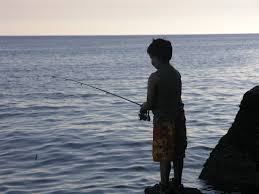
(The fishing story below is borrowed from my book, “Adventures in Youth Ministry.”
When I was about 10 or 11 years old, I lived in Chicago. Once in a while, my Dad would take me fishing to Montrose Beach on Lake Michigan. I would use a fishing pole and cast with a worm on a hook.
But my Dad would troll fish. He’d take this small anchor attached to a long rope, swing it over his head, and throw it into the lake. Next, my Dad attached a metal pulley to the rope with a long line connected to it. The pulley system also had fish hooks on it. Dad would bait the hooks and slowly let the line down in the water. The entire contraption was attached to a metal pole about six or seven feet tall that he would stick into the sand. A small bell was tied to the rope at the top of the pole. If a fish would “hit” one of the hooks, the bell would ring, and then slowly, he’d pull the pulley line in. But guess what? He rarely would catch any fish that way. Come to think about it, neither did I.😊
********************The Point*******************
The Gospels are full of fish stories. Some are about catching fish; others are about not catching fish. There’s even a story about Jesus telling his future disciples to follow Him, and He would make them fishers of men.
Today’s devotion is yet another fish story. This one is about paying the temple tax with coins found in a fish’s mouth.
“When they came to Capernaum, the collectors of the two-drachma tax went up to Peter and said, “Does your teacher not pay the tax?” He said, “Yes.” And when he came into the house, Jesus spoke to him first, saying, “What do you think, Simon? From whom do kings of the earth take toll or tax? From their sons or from others?” And when he said, “From others,” Jesus said to him, “Then the sons are free. However, not to give offense to them, go to the sea and cast a hook and take the first fish that comes up, and when you open its mouth, you will find a shekel. Take that and give it to them for me and for yourself.”
Matthew 17:24-27
Jesus and His disciples are back in Capernaum. This was Jesus’ home base during His earthly ministry, and it was literally Peter’s hometown. So, it’s not unusual for the tax collectors to approach Peter. Perhaps Jesus and the disciples had been gone for a long time, so when the temple tax collector realized they were back in town, they approached Peter.
This two-drachma tax was collected yearly from all Jews to help maintain the temple. Two-drachma was equal to one day’s wage.
When Peter told the tax collectors that Jesus did pay the tax, we can assume he had been with Him when He had paid the tax in the past.
So Peter goes to the house where they are staying. As usual, the all-knowing (omniscient) Jesus already knows what Peter will say. When He asks Peter whether Kings make their sons pay taxes, He refers to Himself.
The temple is God’s house. Jesus is the Son of God. So, Jesus was begging the question, ‘If I’m the Son of God, why should I be asked to pay the tax?’
But Jesus doesn’t want to make a big deal about the tax. If He did, it would draw unnecessary attention to Himself. Also, if Jesus fought paying the tax, it would put Him in a bad light. He would appear not to care about the temple. In addition, we already know that Jesus would be there soon enough, turning over the money-changers tables in righteous anger.
Finally, instead of pulling the coins out of His pocket, Jesus tells Peter to go fishing. He specifically tells him to use a hook, not a net. Peter only needs to catch one fish, and in the mouth of that one fish will be one coin, a shekel. A shekel is the amount necessary to pay the temple tax for two people, Jesus and Peter.
It seems to be a rather strange passage, doesn’t it? The story is partly about a miracle, but we never see one, do we? We, as Christians, must make the presumption that Peter followed through on Jesus’ instructions.
We need to have faith that Peter went to the shore and went fishing with a simple pole, line, and hook. Peter caught the fish, found the coin, and paid the tax.
One might say, “Don’t you think Peter thought this was crazy and might have hesitated to go fishing for a fish with a coin in its mouth?” The answer to that question lies in another passage from Matthew.
“So, Peter got out of the boat and walked on the water and came to Jesus. But when he saw the wind, he was afraid and beginning to sink; he cried out, “Lord, save me.” Jesus immediately reached out his hand and took hold of him, saying to him, “O you of little faith, why did you doubt?”
Matthew 14:29-31
When Peter’s faith weakened because of his fear of the waves and wind, he sank into the water. One would hope and pray that Peter had learned his lesson and would follow Jesus’ words exactly.
Jesus’ instructions to us are the same. Sometimes, He will lead us or tell us to do something that seems strange or impossible. It’s our responsibility as His followers to listen and follow. Jesus knows precisely what He’s doing and exactly what the end result will be.
Dear Jesus. Please help us to always trust you. Even when we are called by You to do things that seem unreasonable or strange to us, allow us to keep our faith strong and follow Your commands. Amen.
 joegministries.com