

The Miracles of Jesus
Lenten/Easter devotions
March 30, 2024
Jesus’ Tomb is Sealed and Guarded
Matthew 27:62-65; 28:11-15
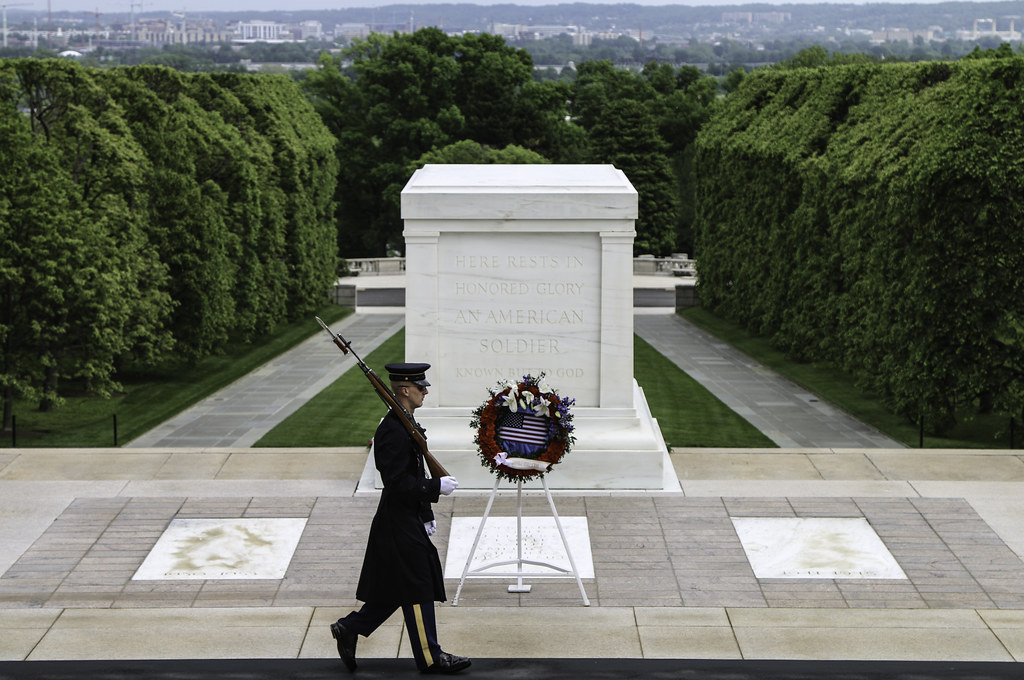
On March 4, 1921, the United States Congress approved the burial of an unidentified American serviceman from World War I in the plaza of the new Memorial Amphitheater. On November 11, 1921, the unknown soldier brought back from France was interred below a three-level marble tomb. The bottom two levels are six granite sections each, and the top has at least nine blocks with a rectangular opening in the center of each level through which the unknown remains were placed through the Tomb and into the ground below. A stone slab, rather than marble, covers the rectangular opening.
The caskets of the WWII & Korean unknowns arrived in Washington on May 28, 1958, where they lay in the Capitol Rotunda until the morning of May 30, when they were carried on caissons to Arlington National Cemetery. President Eisenhower awarded each the Medal of Honor, and the Unknowns of World War II and the Korean War were interred in the plaza beside their World War I comrade.
Twenty-four hours a day, soldiers from the 3rd U.S. Infantry Regiment, known as “The Old Guard,” stand watch over the Tomb. (Wikipedia)
It’s quite a sight watching the changing of the guard at the Tomb of the Unknown Soldier. I had the privilege of watching it in person many years ago. The most amazing thing to me is that the soldiers guarding the Tomb do so in all kinds of weather, 24/7/365.
********************The Point******************
In today’s devotion, the chief priests and the Pharisees ask Pilate to station guards at the Tomb of Jesus. Not to honor him but instead to guard against the disciples stealing the body.
“The next day, that is, after the day of Preparation, the chief priests and the Pharisees gathered before Pilate and said, “Sir, we remember how that impostor said, while he was still alive, ‘After three days I will rise.’ Therefore, order the Tomb to be made secure until the third day, lest his disciples go and steal him away and tell the people, ‘He has risen from the dead,’ and the last fraud will be worse than the first.” Pilate said to them, “You have a guard of soldiers. Go, make it as secure as you can.” So, they went and made the Tomb secure by sealing the stone and setting a guard.”
Matthew 27:62-62
Think about what’s happening in this passage:
- We see the Pharisees and chief priests breaking the Sabbatical rules. These are the same ‘guys’ that accused Jesus of breaking the Sabbath when He performed a miracle.
Now, they were working on the Sabbath, soliciting Pilate for help.
- At this point in time, if I were Pilate, I’d be done with these guys. And guess what? He was.
- Depending on which version you read, there is a discrepancy between who sent the guards to watch over Jesus’ Tomb.
The KJV says, “Pilate said unto them, Ye have a watch: go your way, make it as sure as ye can.”
The word “Ye” means YOU. Pilate basically tells the religious leaders, “You have Temple guards; use them and secure the tomb the best that you can,” and that’s precisely what they did.
The most humorous part of this endeavor is that the priests and Pharisees worry about something that never entered the disciples’ minds.
One of the disciples, Judas, is dead, another disavowed knowing Jesus, Peter, and only one, John, showed up at the crucifixion. They were scared, disillusioned, depressed, and scattered. Grave robbing was the last thing on their minds.
We’re going to take a time jump now. We encounter these guards, Pharisees, and chief priests again about 24-36 hours later. The guards were there when Jesus rose from the dead. Did they see Jesus? No. But they felt another earthquake; they saw an angel roll the stone away from the Tomb. (By the way, the angel rolled the stone away not to let Jesus out, but to let people in, to see that the Tomb was empty.)
Now, it is Resurrection Sunday. Jesus has risen. The women have come to the Tomb to anoint the body. The angel tells the women, “He has Risen.” Mary sees Jesus. The women left to go tell the disciples what they had encountered.
And now Matthew picks up the story of the guards again:
“While they were going, behold, some of the guards went into the city and told the chief priests all that had taken place. And when they had assembled with the elders and taken counsel, they gave a sufficient sum of money to the soldiers. They said, “Tell people, ‘His disciples came by night and stole him away while we were asleep.’ And if this comes to the governor’s ears, we will satisfy him and keep you out of trouble.” So, they took the money and did as they were directed. And this story has been spread among the Jews to this day.”
Matthew 28:11-15
Here are a few things to note from this passage
- Who did the guards go to see first? The church elders and chief priests. This verifies the fact that these were temple guards, not Roman soldiers.
- The elders and chief priests take the guard’s words as truth. They never question them or call them liars.
- Instead, they pay them a large sum of money to keep quiet about what they have seen and tell them to lie about it.
- Not only did the chief priests and elders bribe the guards with money, but they also promised anonymity if anyone questioned the story.
- Why? Why did the elders and chief priests do this?
They wanted to maintain their hold on the people
They wanted to remain the ‘guys’ in charge of the temple and laws
- Little did they know that Jesus would refute what they had done and show their lies simply by appearing to hundreds of people over the next 40 days.
These things were done out of fear, a lack of faith, and a desire to maintain power.
Dear Jesus. Many people have tried to disprove your resurrection. Let us never have the misguided ignorance of those who don’t believe. Instead, please help us keep our faith strong and continue bringing your Gospel message to the world. Amen.
 joegministries.com