
The Miracles of Jesus
Lent – March 23, 2024
Jesus raises Lazarus from the dead
John 11:1-44
As Christians, we generally think of Jesus when we think of someone being raised from the dead. Although I’ve posted and you’ve read devotions about Jesus raising people from the dead, this one is a bit unique.
In the Gospel of Luke 7:11-17, Jesus raises a widow’s son from the dead. In Mark 5:21—24; 35-43, Jesus raised Jairus’s daughter from the dead. In both incidents, Jesus miraculously brought people back to life He did not know intimately. In the case of Lazarus, Jesus raises a friend back from the dead.
********************The Point******************
There is much to be learned from today’s Bible passage. In it, I will point out just several of the crucial things that were going on in this reading. As this Bible story is quite long, I’ll break up the lesson with my remarks and questions. (In blue)
“Now, a man named Lazarus was sick. He was from Bethany, the village of Mary and her sister Martha. (This Mary, whose brother Lazarus now lay sick, was the same one who poured perfume on the Lord and wiped his feet with her hair.) So, the sisters sent word to Jesus, “Lord, the one you love is sick.”
When he heard this, Jesus said, “This sickness will not end in death. No, it is for God’s glory so that God’s Son may be glorified through it.”
John 11:1-4
- If you recognize Mary and Martha’s names, it’s because you’ve read or heard about them before.
This is the same Mary and Martha from Luke 38-42. Jesus had visited their house with His disciples. While Martha was busy getting food ready, Mary sat at Jesus’ feet while He taught. This raised Martha’s ire, who complained to Jesus. But Jesus told her that Mary had made the correct choice in listening and learning.
- The Mary referenced in this story is also the same Mary that John mentions in his Gospel, 12:3. She is the Mary who anointed Jesus’ feet with expensive perfume.
“Now, Jesus loved Martha and her sister and Lazarus. So, when he heard that Lazarus was sick, he stayed where he was two more days, and then he said to his disciples, “Let us go back to Judea.”
Verses 5-7
The Greek word for Jesus’ love for Martha, Mary, and Lazarus is Agape love. This term for the word love means more than saying you’re friends with someone.
“Agape is the godly love that understands those loved, cares for them, and acts in their favor.” (People’s Bible Commentary, John, Gary P. Baumler, Pp. 160.)
“But Rabbi,” they said, “a short while ago, the Jews there tried to stone you, and yet you are going back?”
Jesus answered, “Are there not twelve hours of daylight? Anyone who walks in the daytime will not stumble, for they see by this world’s light. It is when a person walks at night that they stumble, for they have no light.”
After he had said this, he went on to tell them, “Our friend Lazarus has fallen asleep, but I am going there to wake him up.”
His disciples replied, “Lord, if he sleeps, he will get better.” Jesus had been speaking of his death, but his disciples thought he meant natural sleep.
So, then he told them plainly, “Lazarus is dead, and for your sake, I am glad I was not there so that you may believe. But let us go to him.”
Then Thomas (also known as Didymus (11:16 Thomas (Aramaic) and Didymus (Greek) both mean twin.) said to the rest of the disciples, “Let us also go, that we may die with him.”
Verses 8-16
- You’ll notice the disciples warning Jesus not to go back to Judea because the religious leaders wanted to kill Him.
- Jesus’ answer is a bit abstract, but He’s telling His disciples that His life will not end until the appointed time and not a moment before.
- When Jesus tells the disciples that Lazarus has merely fallen asleep, they take what He said literally.
But He then clarifies Himself. Lazarus is dead, and He is going to him to awaken him.
- This moment with the disciple Thomas is much different than the one we know him most for. Here, he shows his faith and asks the rest of the disciples to follow, too, even if it means death.
We generally equate Thomas with the scene after Christ’s death. He does not believe Jesus is alive because he was not with the rest of the disciples when Jesus first appeared to them.
I Am the Resurrection and the Life
“On his arrival, Jesus found that Lazarus had already been in the tomb for four days. Now Bethany was less than two miles from Jerusalem, and many Jews had come to Martha and Mary to comfort them in the loss of their brother. When Martha heard that Jesus was coming, she went out to meet him, but Mary stayed at home.
“Lord,” Martha said to Jesus, “if you had been here, my brother would not have died. But I know that even now, God will give you whatever you ask.”
Jesus said to her, “Your brother will rise again.”
Martha answered, “I know he will rise again in the resurrection at the last day.”
Jesus said to her, “I am the resurrection and the life. The one who believes in me will live, even though they die, and whoever lives by believing in me will never die. Do you believe this?”
“Yes, Lord,” she replied, “I believe that you are the Messiah, the Son of God, who is to come into the world.”
Verses 17-27
- Martha approaches Jesus and His followers as they are approaching Bethany. She believes that if Jesus had gotten there earlier, her brother Lazarus would still be alive.
- Martha believes that there is a resurrection after death.
The remarkable proclamation that comes from Martha’s lips is her following words.
- “Yes, Lord; I believe that you are the Christ, the Son of God, who is coming into the world.”
Jesus Weeps
“After she had said this, she went back and called her sister Mary aside. “The Teacher is here,” she said, “and is asking for you.” When Mary heard this, she got up quickly and went to him. Now, Jesus had not yet entered the village but was still at the place where Martha had met him. When the Jews who had been with Mary in the house, comforting her, noticed how quickly she got up and went out, they followed her, supposing she was going to the tomb to mourn there.
When Mary reached the place where Jesus was and saw him, she fell at his feet and said, “Lord, if you had been here, my brother would not have died.”
When Jesus saw her weeping, and the Jews who had come along with her also weeping, he was deeply moved in spirit and troubled. “Where have you laid him?” he asked.
“Come and see Lord,” they replied.
Jesus wept.
Then the Jews said, “See how he loved him!”
But some of them said, “Could not he who opened the eyes of the blind man have kept this man from dying?”
Verses 28-37
- Now, Martha’s sister Mary comes to Jesus and reiterates her sister’s words.
She, too, believed that if Jesus had been there sooner, He could have healed her brother Lazarus.
- When Jesus saw how she and the other woman were weeping, He wept too.
But Jesus’ weeping was different.
- He was not wailing and carrying on. In Greek, His weeping is different. A tear or two comes from His eye, running down His cheek. Was Jesus crying for His friend Lazarus? Yes. And, perhaps, there was a tear for those who didn’t believe. And, because they didn’t have faith, they would suffer eternal death. Perhaps there was a tear for what was about to happen because it mirrored His upcoming death and resurrection.
Jesus Raises Lazarus
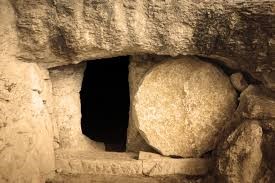
“Jesus, once more deeply moved, came to the tomb. It was a cave with a stone laid across the entrance. “Take away the stone,” he said.
“But, Lord,” said Martha, the sister of the dead man, “by this time, there is a bad odor, for he has been there four days.”
Then Jesus said, “Did I not tell you that if you believe, you will see the glory of God?”
So, they took away the stone. Then Jesus looked up and said, “Father, I thank you that you have heard me. I knew that you always hear me, but I said this for the benefit of the people standing here, that they may believe that you sent me.”
When he had said this, Jesus called in a loud voice, “Lazarus, come out!” The dead man came out, his hands and feet wrapped with strips of linen and a cloth around his face.
Jesus said to them, “Take off the grave clothes and let him go.”
Verses 38-44
- Martha’s reaction is interesting when Jesus tells people to “Take away the stone.”
- Jesus is known for performing miracles, including raising people from the dead.
Instead of thinking about everything Jesus had done in the past and thinking to herself, “He has something huge planned here.”
- She is more concerned about Lazarus’ body condition and the decaying smell.
- Like me, I’m sure you’ve watched plenty of crime shows. Often, there’s a scene when two detectives enter a home or apartment. When they walk into the dwelling, they look at each other, and inevitably, one of them says, “Do you smell that?’
What they’re referring to is the smell of decaying flesh from a dead body.
- But Jesus was not concerned about this at all.
Perhaps He had miraculously caused the body not to decay in advance. Or, when He told people to remove the stone and said, “Lazarus, come out,” Lazarus’ body was restored; thus, there was no smell.
- Finally, Jesus gives instructions to take the burial clothes off Lazarus and let him go.
Lazarus had been released from death’s sting. He was alive.
But Lazarus’ reprieve from death was temporary. He was still human, and someday he would die again.
- Jesus’s death was coming soon, but His death was temporary.
He would rise again in three days
He would and does live eternally
And because of what He did, we, too, have the hope of eternal life.
Dear Jesus. Thank you for all you have taught us from your many miracles. We especially thank you for your sacrifice on the cross for us. You died, so we may live. Amen
 joegministries.com