
An Overview of Galatians
By Joe Guagliardo
Galatians 1:11-24
“Called by God”
June 7, 2023
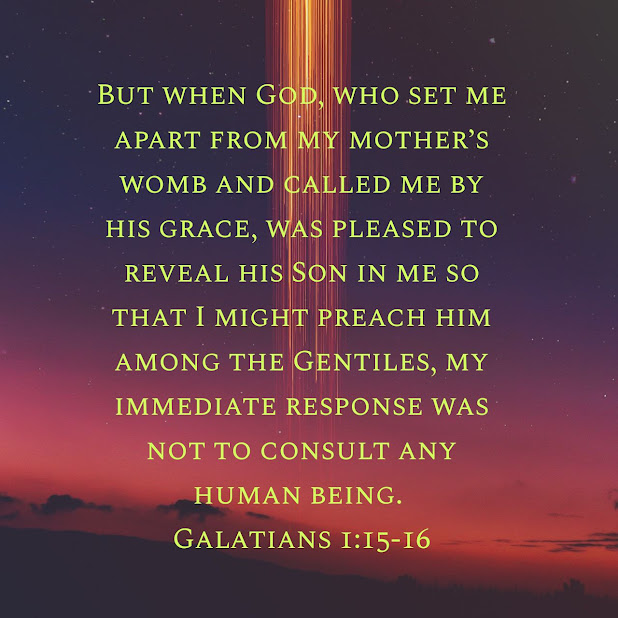
In the church, we hear the words “Called by God” quite often. Okay, a person is called by God to do something. But what does that mean?
Moses was called by God to lead the Israelites out of captivity. David was called by God to be the king of Israel. The Apostles were called by God (Jesus) to learn and make disciples.
Pastors are called by God to lead the churches throughout the world. The list goes on and on. I believe God called me to be a Youth Minister and serve the church for many years.
What does it mean to be called?
“God has chosen to carry out His work in the world through those who are saved. He has determined the tasks He wants each of us to do; our job is to serve Him by accomplishing what He’s planned for us.”
(Christianity.com)
The interesting thing is that at different stages in life, our call sometimes changes. I was called by God to be a Youth Minister. At the age of 65, I retired. I didn’t stop doing God’s work, but it did change. Now, I am writing.
I’ve written a book, “Adventures in Youth Ministry,” plus I write Bible studies and devotions like this one. God has changed my call to be a disciple in a different way.
Obviously, Paul was called by God to be an Apostles and preach, teach, and show the Gentiles the Way to eternal life.

Paul Called by God
“I want you to know, brothers and sisters, that the gospel I preached is not of human origin. I did not receive it from any man, nor was I taught it; rather, I received it by revelation from Jesus Christ.
For you have heard of my previous Way of life in Judaism, how intensely I persecuted the church of God and tried to destroy it. I was advancing in Judaism beyond many of my own age among my people and was extremely zealous for the traditions of my fathers. But when God, who set me apart from my mother’s womb and called me by his grace, was pleased to reveal his Son in me so that I might preach him among the Gentiles, my immediate response was not to consult any human being. I did not go up to Jerusalem to see those who were apostles before I was, but I went into Arabia. Later I returned to Damascus.
Then after three years, I went up to Jerusalem to get acquainted with Cephas (1:18 That is, Peter) and stayed with him fifteen days. I saw none of the other apostles—only James, the Lord’s brother. I assure you before God that what I am writing you is no lie.
Then I went to Syria and Cilicia. I was personally unknown to the churches of Judea that are in Christ. They only heard the report: “The man who formerly persecuted us is now preaching the faith he once tried to destroy.” And they praised God because of me.”
Galatians 1:11-24
Paul highlights several items in these verses. First and foremost, Paul states that Christ called and converted him. We only need to read about Paul in the book of Acts chapter nine to know and believe this.
“Meanwhile, Saul was still breathing out murderous threats against the Lord’s disciples. He went to the high priest and asked him for letters to the synagogues in Damascus so that if he found any there who belonged to the Way, whether men or women, he might take them as prisoners to Jerusalem. As he neared Damascus on his journey, suddenly, a light from heaven flashed around him. He fell to the ground and heard a voice say to him,
“Saul, Saul, why do you persecute me?”
“Who are you, Lord?” Saul asked.
“I am Jesus, whom you are persecuting,” he replied. “Now get up and go into the city, and you will be told what you must do.”
The men traveling with Saul stood there speechless; they heard the sound but did not see anyone. Saul got up from the ground, but when he opened his eyes, he could see nothing. So, they led him by the hand into Damascus. For three days, he was blind and did not eat or drink anything.
In Damascus, there was a disciple named Ananias. The Lord called to him in a vision, “Ananias!”
“Yes, Lord,” he answered.
The Lord told him, “Go to the house of Judas on Straight Street and ask for a man from Tarsus named Saul, for he is praying. In a vision, he has seen a man named Ananias come and place his hands on him to restore his sight.”
“Lord,” Ananias answered, “I have heard many reports about this man and all the harm he has done to your holy people in Jerusalem. And he has come here with authority from the chief priests to arrest all who call on your name.”
But the Lord said to Ananias, “Go! This man is my chosen instrument to proclaim my name to the Gentiles and their kings and to the people of Israel. I will show him how much he must suffer for my name.”
Then Ananias went to the house and entered it. Placing his hands-on Saul, he said, “Brother Saul, the Lord—Jesus, who appeared to you on the road as you were coming here—has sent me so that you may see again and be filled with the Holy Spirit.” Immediately, something like scales fell from Saul’s eyes, and he could see again. He got up and was baptized, and after taking some food, he regained his strength.”
Acts 9:1-19
Paul has an incredibly, credible story in the Book of Acts that specifically details Christ calling him to be an Apostle. Paul reiterates his call to the Galatians.
We have a detailed account written down by Luke. His account details the circumstances of Paul’s/Saul’s conversion.
An interesting question you or I might ask is, “Why did Paul take three years before he reached out to and met Peter?”
“Then, after three years, I went up to Jerusalem to get acquainted with Cephas (1:18 That is, Peter) and stayed with him fifteen days.”
Galatians 1:18
During the three years, Paul was set apart from the other Apostles. Although Paul traveled and taught during these three years, he was still a student of Christ. God guided him and schooled him directly.
“When he did go (to Jerusalem to meet Peter), it was not to receive instruction or approval for his message. Rather, he went to get acquainted with the great apostle Peter.”
(Peoples Bible Commentary, Galatian/Ephesians, Pp.29)
Finally, after meeting with Peter (and meeting James, the brother of Jesus), Paul stayed in Syria and Cilicia.
While in Jerusalem, Paul talked and debated with Grecian Jews. They did not appreciate what he had to say, and, tried to kill him. He was then sent to Syria for his own protection.
Although Paul was known by the people in this area to have persecuted the Jews,
“The man who formerly persecuted us in so preaching the faith he once tried to destroy. And they praised God because of Him.”
Galatians 1:23b-24
Once again, Paul was emphasizing to the Galatians that he was called by God, had the approval of the other Apostles, and was not making up anything that he spoke or taught.
 joegministries.com